

ADDCOMPOSITES BLOG
Advanced Hybrid Composites Manufacturing - Integrating Carbon Fiber Tape with Glass Fiber Thermoplastics
Introduction
In the ever-evolving landscape of advanced materials, long fiber thermoplastic (LFT) composites have emerged as a cornerstone technology in the automotive and transportation sectors. Their appeal lies in a compelling combination of characteristics: ease of processing, recyclability, superior specific modulus, and excellent impact resistance. However, as industry demands grow more sophisticated, manufacturers face an increasing challenge: how to enhance the mechanical properties of LFT composites while maintaining their processing advantages?
The Challenge in Modern Composite Manufacturing
Traditional manufacturing methods for LFT composites face several limitations:
- Injection Molding (IM): While providing higher mechanical properties in the flow direction, it results in significant fiber attrition due to shear stresses in the compounding screw.
- Extrusion Compression Molding (ECM): Offers better fiber length retention and pseudo-isotropic properties but is limited by the aspect ratio of discontinuous fiber.
These limitations have sparked a search for innovative manufacturing solutions that can overcome these constraints while maintaining the advantages of both processes.
A Revolutionary Approach: Hybrid Manufacturing
Enter a groundbreaking solution: the integration of Automated Fiber Placement (AFP) with traditional LFT manufacturing. This hybrid approach combines:
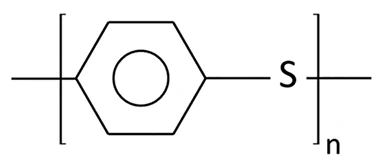
- Glass fiber reinforced polyphenylene sulfide long fiber thermoplastic (G-LFT) manufactured via ECM
- Unidirectional continuous carbon fiber/polyphenylene sulfide tape (CF-Tape) applied through ATP
This innovative combination represents a significant leap forward in composite manufacturing technology. The process leverages the strengths of both materials and manufacturing methods:
- G-LFT provides the base structure with its excellent impact resistance and processing characteristics
- CF-Tape enhances local mechanical properties through precise placement and continuous fiber reinforcement
Why This Matters
The significance of this development extends beyond mere technical innovation. In an era where lightweight, high-performance materials are crucial for advancing sustainable transportation and industrial applications, this hybrid manufacturing approach offers:
- Up to 192% improvement in flexural strength
- 129% enhancement in tensile properties
- Maintained impact resistance properties
- Potential for localized reinforcement in critical areas
As industries push towards more efficient manufacturing processes, this hybrid approach represents a significant step forward in addressing the growing demand for high-performance composite materials while maintaining practical manufacturing considerations.
In the following sections, we'll delve deeper into the materials, manufacturing processes, and remarkable results achieved through this innovative approach to composite manufacturing.
Understanding the Materials: The Building Blocks of Advanced Hybrid Composites
The success of this hybrid manufacturing approach lies in the careful selection and integration of two distinct composite materials. Let's explore these materials and understand why they form such an effective combination.
Glass Fiber Reinforced Polyphenylene Sulfide (G-LFT)
Glass fiber reinforced composites have become a cornerstone in modern manufacturing, particularly in the form of Long Fiber Thermoplastic (LFT) composites. The specific material used in this innovation consists of:
Material Composition
- 40% weight glass fiber reinforcement
- Polyphenylene sulfide (PPS) matrix
- 12.7mm (½-inch) pellet length
Why PPS as the Matrix?
PPS isn't just another polymer matrix - it's an engineering thermoplastic that brings several crucial advantages:
- Thermal Properties
- High-temperature resistance
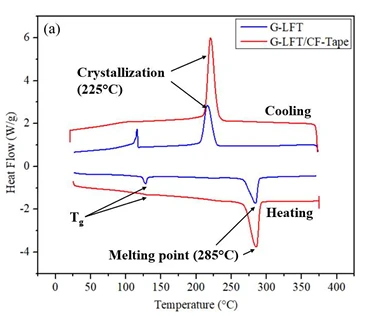
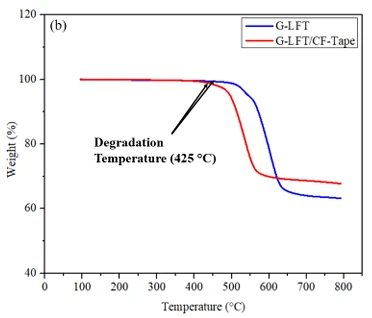
- Thermal stability up to 425°C
- Glass transition temperature: 125-130°C
- Melting point: 280-285°C
- Structural Benefits
- Superior strength characteristics
- Excellent chemical resistance
- Notable wear resistance
- Low coefficient of thermal expansion
- Processing Advantages
- Semi-crystalline nature (33.4% crystallinity)
- Good processability
- Maintains modulus above glass transition temperature
Carbon Fiber/PPS Tape (CF-Tape)
The second component of this hybrid system is the continuous carbon fiber reinforced tape, which brings its own set of distinctive characteristics:
Material Specifications
- 66% weight carbon fiber content
- PPS matrix system
- 12.7mm (½-inch) width
- 0.16mm approximate thickness
- Unidirectional fiber orientation
Strategic Advantages
- Mechanical Performance
- High specific strength
- Superior modulus
- Excellent fatigue resistance
- Processing Considerations
- Compatible matrix system with G-LFT
- Suitable for automated placement
- Good consolidation characteristics
The Synergistic Effect
The combination of these materials creates a synergistic effect that overcomes the limitations of each individual component:
- Interface Bonding
- Matching PPS matrices enable strong molecular chain interdiffusion
- Achieved flatwise tensile strength of 7.52 MPa
- Good consolidation under ATP processing conditions
- Thermal Behavior
- Similar melting and crystallization points enable effective processing
- Maintains structural integrity across a wide temperature range
- Consistent crystallinity between components (≈33.4-33.5%)
- Structural Enhancement
- G-LFT provides robust base structure
- CF-Tape enables localized reinforcement
- Complementary failure mechanisms enhance overall toughness
Material Selection Considerations
When designing for automated fiber placement, the choice of these specific materials wasn't arbitrary. Key factors included:
- Processing Window Compatibility: Similar processing temperatures and crystallization behavior
- Mechanical Property Enhancement: Complementary strength characteristics
- Manufacturing Feasibility: Suitability for both ECM and ATP processes
- Cost-Performance Balance: Optimal use of expensive carbon fiber reinforcement
This careful material selection forms the foundation for the remarkable property improvements achieved in the final hybrid composite. The next section will delve into how these materials are brought together through innovative manufacturing processes.
The Manufacturing Process: Combining Traditional and Advanced Techniques
The success of this hybrid composite lies not just in the materials selected, but in the innovative manufacturing approach that combines traditional and cutting-edge processes. Let's explore how automated manufacturing techniques are revolutionizing composite production.
A Two-Step Manufacturing Approach
The manufacturing process is divided into two distinct steps, each crucial for achieving the desired properties in the final component:
Step 1: Base Component Manufacturing via ECM
The first step involves creating the G-LFT substrate through Extrusion Compression Molding (ECM). This process involves:
- Material Preparation
- Drying G-LFT pellets at 100°C for 8 hours
- Ensuring moisture-free processing conditions
- Extrusion Process
- Single screw extruder operation at 0.454g/min feed rate
- Four-zone heating profile:
- Zone 1: 295°C
- Zone 2: 300°C
- Zone 3: 305°C
- Nozzle: 310°C
- Compression Molding
- Transfer of 38cm molten charge to hydraulic press
- Processing parameters:
- Pressure: 2.89 MPa (420 psi)
- Dwell time: 60 seconds
- Panel dimensions: 280mm × 280mm
Step 2: Advanced Fiber Placement
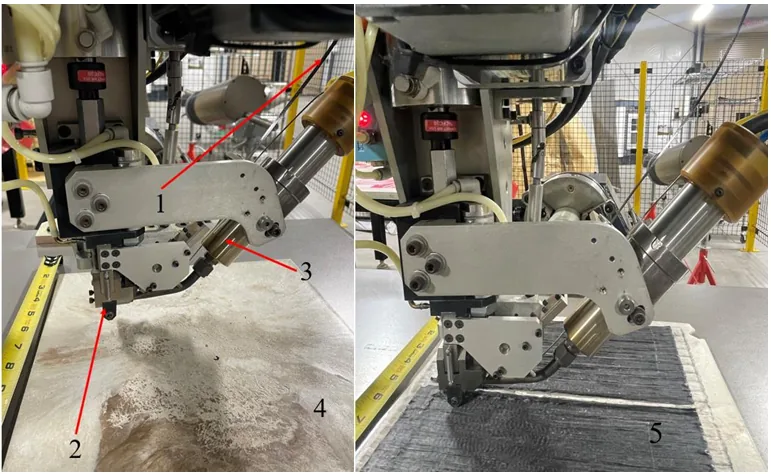
The second step utilizes Automated Fiber Placement (AFP) technology to apply the CF-Tape. This process represents a significant advancement in composite manufacturing:
- Equipment Setup
- KAWASAKI ZZX130L 6-axis robot
- Hot gas torch (HGT) heating system
- Specialized tape dispensing system
- Stainless-steel compaction roller
- Process Parameters
- HGT temperature: 840°C at source
- Nip point temperature: ~290°C
- Compaction force: 63.5 Kg (140 lb)
- Roller diameter: 12.7mm
Critical Process Elements
Several factors are crucial for achieving optimal results in this hybrid manufacturing approach:
Temperature Control
- Precise monitoring using Teledyne FLIR A700-EST IR camera
- Maintaining optimal nip point temperature
- Careful control of heating zones in ECM
Interface Development
During the ATP process, two key phenomena occur:
- Intimate Contact Formation
- Flattening of surface asperities
- Reduction of interlaminar voids
- Pressure-assisted consolidation
- Molecular Diffusion
- Chain interdiffusion between layers
- Development of strong interfacial bonding
- Enhanced structural integrity
Process Optimization Considerations
To achieve optimal results, several factors require careful attention:
- Material Conditioning
- Proper drying protocols
- Temperature management
- Moisture control
- Process Parameters
- Speed and feed rate optimization
- Temperature profile management
- Pressure application control
- Quality Control
- Real-time temperature monitoring
- Pressure distribution verification
- Visual inspection of tape placement
Manufacturing Challenges and Solutions
Several challenges were addressed during process development:
- Temperature Management
- Challenge: Maintaining consistent nip point temperature
- Solution: Advanced IR monitoring and control systems
- Interface Quality
- Challenge: Achieving consistent bonding
- Solution: Optimized pressure and temperature parameters
- Process Control
- Challenge: Maintaining precise tape placement
- Solution: Automated robotic control systems
Future Manufacturing Considerations
The success of this process opens doors for several manufacturing improvements:
- Scalability Options
- Integration with existing production lines
- Potential for increased automation
- Multiple tape placement capabilities
- Process Refinements
- Enhanced temperature control systems
- Improved material handling
- Advanced monitoring capabilities
This manufacturing approach demonstrates how traditional processes can be enhanced through the integration of advanced automation technologies, leading to superior composite properties while maintaining practical production considerations.
Results and Performance: Quantifying the Benefits of Hybrid Composites
The effectiveness of combining AFP technology with traditional composites is best demonstrated through comprehensive performance analysis. Let's examine the remarkable improvements achieved through this hybrid manufacturing approach.
Mechanical Property Enhancements
Flexural Performance
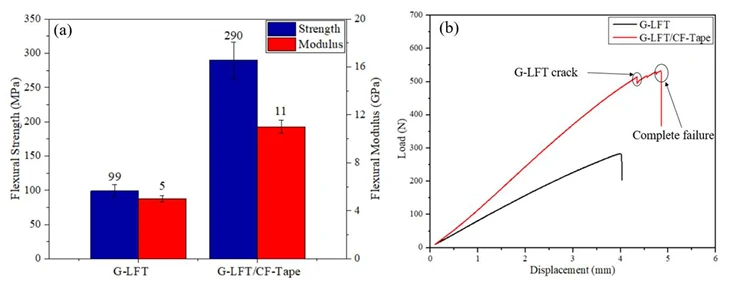
The addition of CF-Tape through ATP resulted in dramatic improvements in flexural properties:
- Strength Improvements
- Base G-LFT: 99 MPa
- Hybrid composite: 290 MPa
- Net improvement: 192%
- Modulus Enhancement
- Base G-LFT: 5.09 GPa
- Hybrid composite: 11.04 GPa
- Net improvement: 120%
Tensile Properties
Tensile testing revealed significant strengthening:
- Strength Gains
- Base G-LFT: 51 MPa
- Hybrid composite: 117 MPa
- Net improvement: 129%
- Modulus Increase
- Base G-LFT: 8 GPa
- Hybrid composite: 13 GPa
- Net improvement: 62%
Interface Bonding Characteristics
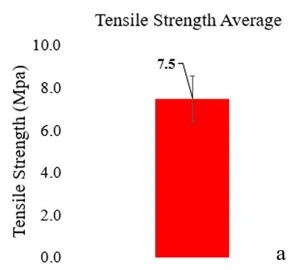
The critical interface between materials showed impressive performance:
- Flatwise Tensile Strength
- Average strength: 7.52 MPa ±0.34
- Consistent performance across samples
- Partial CF-Tape failure indicating strong adhesion
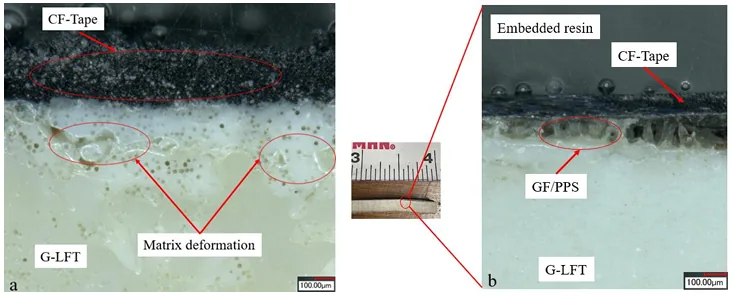
- Morphological Analysis
- Good interfacial contact
- Minimal void content
- Evidence of molecular interdiffusion
Thermal Analysis Results
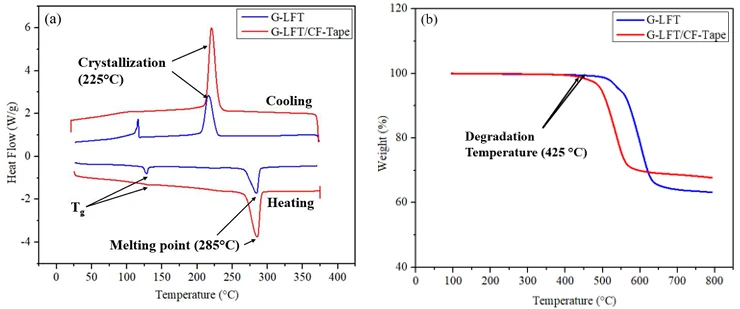
Differential Scanning Calorimetry (DSC)
Key thermal characteristics were maintained:
- Temperature Transitions
- Glass transition (Tg): 125-130°C
- Melting point: 280-285°C
- Recrystallization: 245°C
- Crystallinity Analysis
- G-LFT: 33.4%
- Hybrid composite: 33.5%
- Maintained crystallinity despite processing
Thermogravimetric Analysis (TGA)
Thermal stability showed promising results:
- Degradation Behavior
- Onset temperature: 425°C
- Less than 1% weight loss up to 425°C
- Complete degradation:
- G-LFT: 650°C
- Hybrid composite: 575°C
- Residual Content
- G-LFT: 62% residue (close to initial 60% fiber content)
- Hybrid composite: 66% residue (reflecting added CF content)
Impact Performance
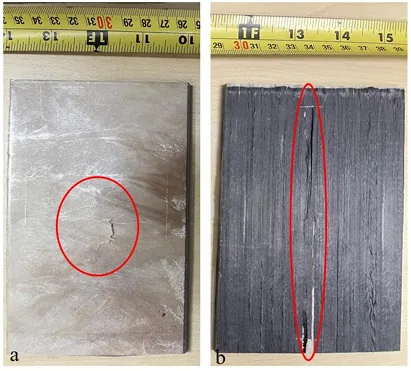
Low-velocity impact testing revealed interesting characteristics:
- Energy Absorption
- Input energy: 34.02 J
- Similar total energy absorption between base and hybrid
- Different failure mechanisms observed
- Failure Characteristics
- G-LFT: Hemispherical-shaped crack pattern
- Hybrid: Vertical crack along CF orientation
- Enhanced damage tolerance in hybrid structure
Impact Test Results Summary
- Average Contact Force:
- G-LFT: 3010.12 ± 284.30 N
- Hybrid: 2886.09 ± 287.30 N
- Average Deformation:
- G-LFT: 16.96 ± 2.34 mm
- Hybrid: 19.56 ± 1.87 mm
Numerical Analysis Insights
Finite Element Analysis provided additional understanding:
- Stress Distribution
- More uniform stress distribution in hybrid structure
- Improved load transfer characteristics
- Progressive failure behavior
- Layer Analysis
- Multiple CF-Tape layers showed additive benefits
- Up to 60% strength increase with five layers
- Optimized stress distribution through thickness
Performance Validation
The results demonstrate that this hybrid manufacturing approach successfully:
- Enhances Mechanical Properties
- Significant strength improvements
- Maintained impact resistance
- Good interfacial bonding
- Maintains Processing Advantages
- Consistent thermal properties
- Reliable manufacturing process
- Scalable approach
- Provides Design Flexibility
- Local reinforcement capabilities
- Customizable properties
- Adaptable to various applications
These results validate the effectiveness of combining ATP with traditional composite manufacturing, opening new possibilities for high-performance composite applications.
Future Implications: The Road Ahead for Hybrid Composite Manufacturing
The successful integration of Automated Fiber Placement (AFP) with traditional composite manufacturing opens up exciting possibilities for the future of materials engineering. Let's explore the implications and potential developments of this innovative approach.
Industrial Applications
Automotive Sector
The automotive industry stands to benefit significantly from this technology:
- Structural Components
- Lightweight body panels
- High-strength chassis elements
- Impact-resistant safety components
- Powertrain Applications
- Electric motor components
- Battery enclosures
- Transmission housings
Aerospace Applications
The aerospace sector presents numerous opportunities:
- Primary Structures
- Fuselage panels
- Wing components
- Control surfaces
- Secondary Components
- Interior panels
- Cargo liners
- Access doors
Energy Sector
Renewable energy applications show particular promise:
- Wind Energy
- Turbine blades
- Nacelle components
- Structural supports
- Hydrogen Storage
- Pressure vessels
- Transport containers
- Storage systems
Manufacturing Scalability
Process Optimization
Future manufacturing developments will likely focus on:
- Automation Enhancement
- Improved robotic systems
- Advanced sensor integration
- Real-time quality control
- Production Efficiency
- Higher placement speeds
- Reduced material waste
- Optimized cure cycles
Cost Considerations
The technology presents several opportunities for cost optimization:
- Material Costs
- Strategic use of expensive carbon fiber
- Optimized material placement
- Reduced waste through precise application
- Processing Costs
- Increased automation
- Reduced labor requirements
- Improved energy efficiency
Potential Improvements
Material Development
Future research may focus on:
- Matrix Systems
- Enhanced interfacial bonding
- Improved processing characteristics
- Advanced thermoplastic systems
- Fiber Technology
- Novel fiber combinations
- Improved fiber architectures
- Enhanced fiber properties
Process Innovations
Next-generation manufacturing approaches might include:
- Smart Manufacturing
- AI-driven process control
- Machine learning optimization
- Digital twin integration
- Quality Assurance
- In-situ monitoring systems
- Advanced NDT techniques
- Automated defect detection
Sustainability Considerations
The future of this technology must address environmental concerns:
- Material Recycling
- Enhanced recyclability
- Waste reduction strategies
- Circular economy integration
- Energy Efficiency
- Reduced processing energy
- Optimized thermal management
- Sustainable manufacturing practices
Research Directions
Future research will likely explore:
- Material Science
- Interface optimization
- New material combinations
- Property enhancement
- Process Development
- Advanced processing techniques
- Multi-material integration
- Hybrid process optimization
Industry Integration
The successful implementation will require:
- Standards Development
- Manufacturing guidelines
- Quality standards
- Testing protocols
- Workforce Development
- Technical training programs
- Skill development
- Knowledge transfer
The Path Forward
The future of hybrid composite manufacturing looks promising, with several key areas of focus:
- Technology Development
- Continuous process improvement
- Enhanced automation
- Advanced material systems
- Market Expansion
- New application areas
- Industry adoption
- Cost optimization
- Sustainability Integration
- Environmental considerations
- Resource efficiency
- Circular economy principles
This innovative manufacturing approach represents a significant step forward in composite technology, with the potential to revolutionize multiple industries while addressing crucial sustainability and performance requirements.
Conclusion: A New Chapter in Composite Manufacturing
The integration of Automated Fiber Placement (AFP) with traditional composite manufacturing represents more than just a technical advancement—it marks a significant milestone in the evolution of composite manufacturing. Let's summarize the key insights and implications of this innovative approach.
Key Achievements
Performance Improvements
The hybrid manufacturing technique has delivered remarkable enhancements:
- 192% increase in flexural strength
- 129% improvement in tensile properties
- Maintained impact resistance
- Excellent interfacial bonding (7.52 MPa flatwise tensile strength)
Manufacturing Innovation
The process successfully combines:
- Traditional ECM for base structure formation
- Advanced ATP technology for selective reinforcement
- Precise control over material placement and properties
Significance for Industry
Manufacturing Evolution
This development represents a significant step forward in composite manufacturing technology:
- Process Integration
- Successful merging of traditional and advanced techniques
- Scalable manufacturing approach
- Enhanced quality control capabilities
- Design Flexibility
- Targeted reinforcement possibilities
- Customizable mechanical properties
- Application-specific optimization
Industry Impact
The implications extend across multiple sectors:
- Automotive
- Lightweight structural components
- Enhanced safety features
- Improved performance characteristics
- Aerospace
- Advanced aerostructures
- Weight reduction opportunities
- Performance optimization
Looking Ahead
Future Development Paths
The technology opens several avenues for advancement:
- Material Innovation
- New material combinations
- Enhanced interface properties
- Improved processing characteristics
- Process Optimization
- Advanced automation
- Increased efficiency
- Reduced manufacturing costs
Sustainability Focus
Environmental considerations remain central:
- Enhanced material efficiency
- Reduced waste through precise placement
- Improved recyclability potential
Final Thoughts
The successful development of this hybrid manufacturing approach demonstrates the potential for innovation in composite materials and processing. It shows that by combining traditional methods with advanced automation, we can achieve:
- Superior Performance
- Enhanced mechanical properties
- Maintained practical processing
- Improved quality control
- Practical Implementation
- Scalable manufacturing
- Cost-effective processing
- Broad application potential
- Future Readiness
- Sustainable manufacturing practices
- Adaptable technology platform
- Continuous improvement potential
This advancement in composite manufacturing not only solves current challenges but also paves the way for future innovations. As we continue to push the boundaries of material science and manufacturing technology, such hybrid approaches will become increasingly important in meeting the demanding requirements of modern industrial applications.
The success of this technology serves as a reminder that significant advances often come not from completely new technologies, but from innovative combinations of existing ones. It demonstrates that the future of composite manufacturing lies not just in developing new materials or processes, but in finding smart ways to integrate and optimize what we already have.
As we move forward, this hybrid manufacturing approach stands as a testament to the power of innovative thinking in materials engineering and sets a new standard for what can be achieved in composite manufacturing.
References
This blog post is based on the research paper:
Chahine, G., Barakat, A., White, B., Schwartz, B., Marathe, U., Yeole, P., Hassen, A. A., & Vaidya, U. (2024). Advanced Hybrid Composites: Integrating Carbon Fiber Tape into Glass Fiber Thermoplastics Via Automated Tape Placement Overmolding. University of Tennessee and Oak Ridge National Laboratory.
Additional Resources
For more information on composite manufacturing and AFP technology, explore these related articles:
- Understanding Automated Fiber Placement (AFP)
- Composite Materials Guide
- Advanced Manufacturing Techniques
- Thermoplastic Composites Overview
Take Your Composite Manufacturing to the Next Level
Are you ready to revolutionize your composite manufacturing processes? Addcomposites offers cutting-edge solutions for automated fiber placement that can help you achieve:
- Enhanced mechanical properties
- Precise material placement
- Cost-effective manufacturing
- Superior quality control
Get Started with Addcomposites
Explore Our Solutions
Why Choose Addcomposites?
- Industry-leading expertise
- Proven track record
- Comprehensive support
- Innovative solutions
Contact Us
Ready to transform your composite manufacturing capabilities? Contact our team of experts today:
- Website: www.addcomposites.com
- Email: info@addcomposites.com
- Follow us on LinkedIn for the latest updates
Transform your manufacturing process with Addcomposites - Where Innovation Meets Excellence
This blog post was created based on research conducted at the University of Tennessee and Oak Ridge National Laboratory. We thank the authors for their groundbreaking work in advancing composite manufacturing technology.