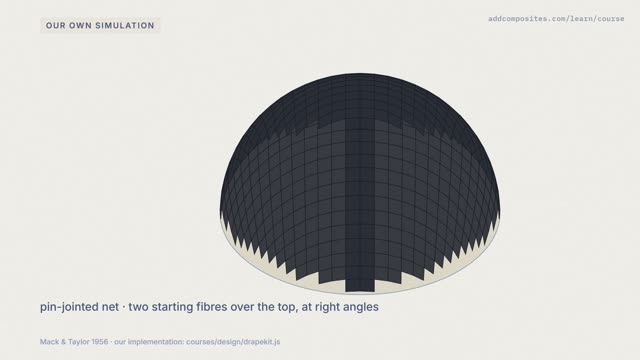

Where is zero degrees?
Ply angles are measured from a declared 0° reference, the rosette (origin + 0° direction). On a curved surface the direction has to be carried across the surface by a rule, and a plain projection fails where the surface faces along it; AddPly's rosette offers standard, translational and radial mapping and, in this build, says it is declared intent only: no fibre path computed.
Predict · at 0:45 in the video
So on a curved part, where is zero degrees?
Wherever you declare it, by a rule you choose. AddPly's rosette offers three mapping types: standard, translational and radial. Which rule is right depends on the part.
This course is our own. These books go deeper.
- Basic Mechanics of Laminated Composite Plates, A. T. Nettles, NASA Reference Publication 1351, 1994
- Mechanics of Composite Materials, R. M. Jones, Taylor & Francis, 2nd ed., 1999
- Engineering Mechanics of Composite Materials, I. M. Daniel & O. Ishai, Oxford University Press, 2nd ed., 2006
- Design and Analysis of Composite Structures, C. Kassapoglou, Wiley, 2nd ed., 2013
- Composite Materials Handbook (CMH-17), Volume 3, Rev. G, CMH-17, SAE International, 2012
The course designs in AddPly, our browser app for laminate design: regions, ply stacks with live stacking-rule checks, thickness, mass and the ply book. It does not do strength, failure or draping; where a lesson covers those, the simulation is our own.
Simulations in this lesson are our own. Ply data come from the datasheet or textbook named on screen; where a number rests on an assumption, the video says so.