
The direction is the design
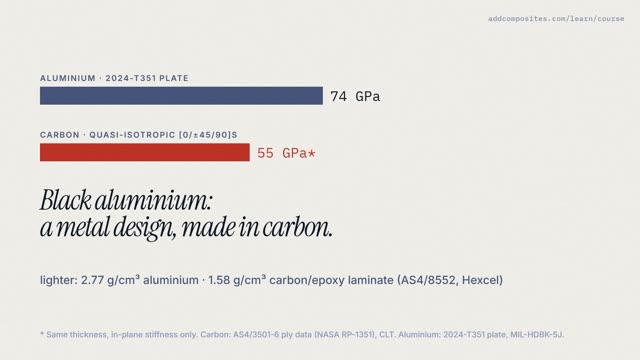
A unidirectional carbon ply is about 15 times stiffer along its fibres than across them, and only 15° off-axis it keeps less than half its stiffness. So the fibre angles are not a detail of a composite part: they are the design.
Predict · at 0:48 in the video
Now pull at just fifteen degrees off the fibres. How much of that stiffness is left? Most of it, about three quarters, or less than half?
Less than half. About 64 gigapascals. Keep turning, and it keeps falling: 27 at thirty degrees, 15 at forty-five, and 9 straight across.
This course is our own. These books go deeper.
- Basic Mechanics of Laminated Composite Plates, A. T. Nettles, NASA Reference Publication 1351, 1994
- Mechanics of Composite Materials, R. M. Jones, Taylor & Francis, 2nd ed., 1999
- Engineering Mechanics of Composite Materials, I. M. Daniel & O. Ishai, Oxford University Press, 2nd ed., 2006
- Design and Analysis of Composite Structures, C. Kassapoglou, Wiley, 2nd ed., 2013
- Composite Materials Handbook (CMH-17), Volume 3, Rev. G, CMH-17, SAE International, 2012
The course designs in AddPly, our browser app for laminate design: regions, ply stacks with live stacking-rule checks, thickness, mass and the ply book. It does not do strength, failure or draping; where a lesson covers those, the simulation is our own.
Simulations in this lesson are our own. Ply data come from the datasheet or textbook named on screen; where a number rests on an assumption, the video says so.