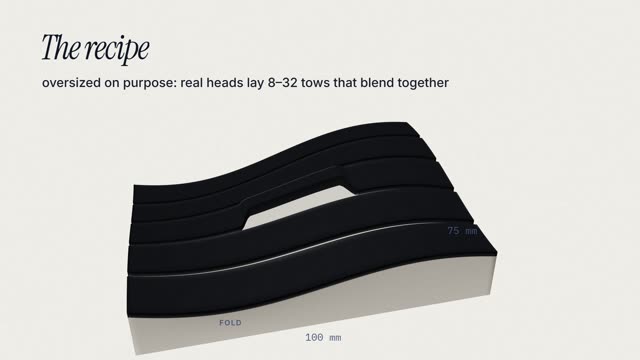

Splice, angle deviation, position error, FOD
The last four defects come from outside the tow path: the spool (splice), the aim of the course (angle deviation, position error) and the room (FOD). Angle deviation gets the numbers: fibres only carry load along their length, so a unidirectional ply's stiffness falls off fast as it turns away from the load: about 16 % gone at 5°, 42 % at 10°. Then all 14 defects on one map.
Predict · at 1:36 in the video
But the bigger question is stiffness. A zero-degree ply ends up five degrees off. How much stiffness does it lose along the direction it was meant for?
About sixteen percent. Fibres only carry load along their length. Turn them even slightly away from the load, and the softer resin and the shear between fibres start taking a share.
Automated Fiber Placement: Status, Challenges, and Evolution, Ramy Harik & Alex Brasington.
- Chapter 3, section 2.12
- Chapter 3, section 2.6
- Chapter 3, section 2.13
- Chapter 3, section 2.14
Simulations in this lesson are our own. Where the numbers are invented to show a mechanism, the video says so on screen.