
Fold, twist, wandering, loose, missing tow
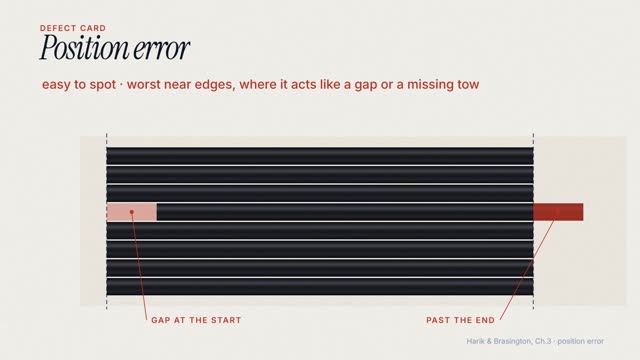
These five defects happen to the tow itself, somewhere between spool and nip, and each one starts at a particular place on the tow path: the spool and feed (missing tow), the guides (twist), the tensioner (fold), and the unsupported span after the cutter (wandering and loose tows). The wandering tow has a clean piece of geometry: once cut, the last stretch L can't be steered, runs straight, and lands about L²/(2R) off a curved path. That's why tight steering is avoided where the tow is unsupported.
Predict · at 2:24 in the video
Now the tow after the cutter. Say its last hundred millimetres aren't held by anything, and the path curves at a five-hundred-millimetre radius. How far off the path can its end land?
About ten millimetres. More than a whole tow width. Here's why.
Automated Fiber Placement: Status, Challenges, and Evolution, Ramy Harik & Alex Brasington.
- Chapter 3, section 2.7
- Chapter 3, section 2.8
- Chapter 3, section 2.9
- Chapter 3, section 2.10
Simulations in this lesson are our own. Where the numbers are invented to show a mechanism, the video says so on screen.