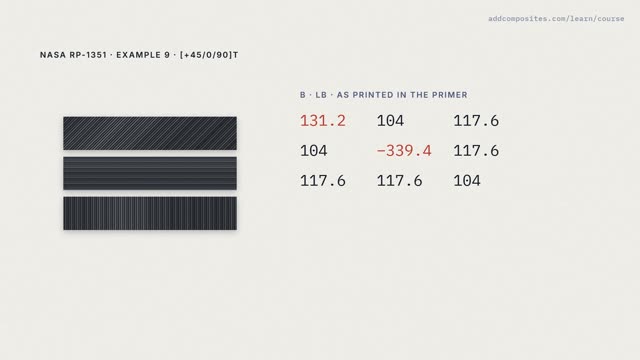

D: bending and order
D weights each ply by the cube of its distance from the mid-plane, so the same eight plies bend very differently in different orders: [0/45/−45/90]s has D11 = 31,236 and D22 = 8,146 N·mm (AddPly shows the same), a bending modulus of 90 GPa along 0° and 22 along 90°; flip to [90/45/−45/0]s and those swap.
Predict · at 0:49 in the video
Now flip the order: nineties outside, zeros in the middle. Same plies. What happens to the bending stiffness along zero?
They swap. Along zero, it drops from 90 to 22 gigapascals. Along ninety, it rises from 22 to 90.
This course is our own. These books go deeper.
- Basic Mechanics of Laminated Composite Plates, A. T. Nettles, NASA Reference Publication 1351, 1994
- Mechanics of Composite Materials, R. M. Jones, Taylor & Francis, 2nd ed., 1999
- Engineering Mechanics of Composite Materials, I. M. Daniel & O. Ishai, Oxford University Press, 2nd ed., 2006
- Design and Analysis of Composite Structures, C. Kassapoglou, Wiley, 2nd ed., 2013
- Composite Materials Handbook (CMH-17), Volume 3, Rev. G, CMH-17, SAE International, 2012
The course designs in AddPly, our browser app for laminate design: regions, ply stacks with live stacking-rule checks, thickness, mass and the ply book. It does not do strength, failure or draping; where a lesson covers those, the simulation is our own.
Simulations in this lesson are our own. Ply data come from the datasheet or textbook named on screen; where a number rests on an assumption, the video says so.