

ADDCOMPOSITES BLOG
When Wind Blades Retire: Recycling, Second Life, and the Carbon Fibre Question
When Wind Blades Retire: Recycling, Second Life, and the Carbon Fibre Question
Wind power keeps growing, and so does a quieter problem sitting at the other end of the turbine's life. The blades that make clean electricity possible are built to survive decades of storms, fatigue, and UV exposure. That same toughness is exactly what makes them so hard to deal with once they come down.
A new open-access review published in Energies (MDPI) in September 2025 takes a system-level look at what actually happens to wind turbine components at end of life. Written by Natalia Cieślewicz, Krzysztof Pilarski, and Agnieszka A. Pilarska of Poznań University of Life Sciences, the paper walks through three broad routes: keeping turbines running longer, giving decommissioned parts a second life, and recovering materials through mechanical, thermal, and chemical recycling. Crucially, it does not stop at the technology — it ties each route to how mature it is, what it costs, and which policy and finance levers are needed to make it work at scale.
This post summarizes what the review reports and adds our own commentary on where automated fiber placement (AFP) manufacturers fit into the picture. Throughout, we keep a clear line between what the authors present and what is Addcomposites' editorial view.
Everything attributed to "the review," "the authors," or "the paper" comes from Cieślewicz, Pilarski & Pilarska (2025), cited in full at the end. The ASCII-style charts in the source draft have been rebuilt below as interactive figures — they are Addcomposites' own visualizations built from data reported in the paper, not reproductions of its own figures (Figure 1 below is the one exception, reproduced directly under CC BY 4.0).
The scale of the problem
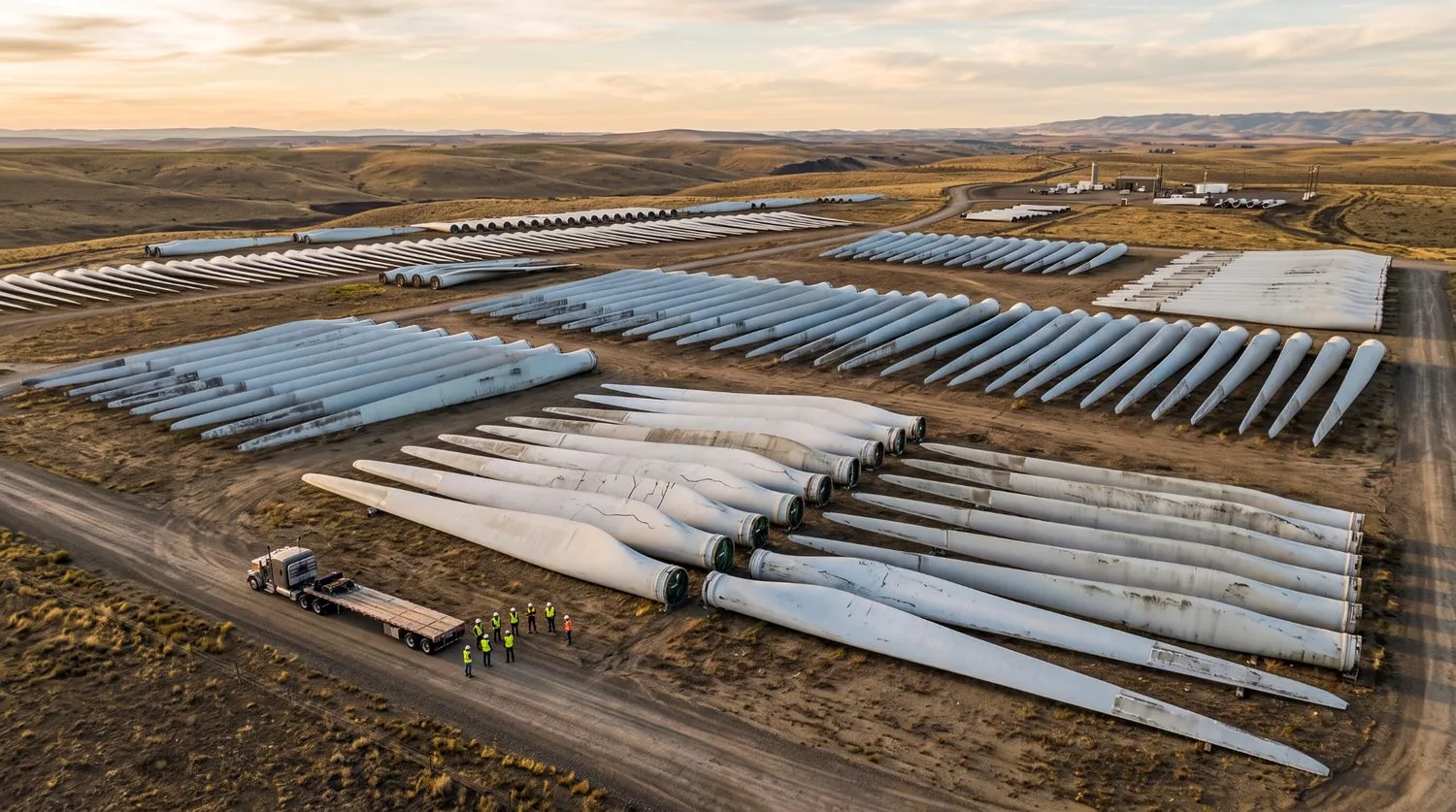
Rows of retired blades await processing at a storage yard, illustrating the scale of composite waste facing the wind sector by mid-century. (Illustrative image.)
The review frames the challenge with some blunt numbers. Global installed wind capacity reached 907 GW in 2022 and is projected to pass 2,000 GW by 2030, with wind generation in 2022 reported at 2,100 TWh. All of that hardware eventually ages out. The authors cite estimates putting worldwide turbine waste somewhere in the 325–495 kilotonne range by mid-century, dominated by blade composites.
The paper is careful to distinguish the turbine from the blade. For older machines like the Vestas V52, the authors note that as much as 80–90% of the turbine's mass can already be recovered with existing methods — the steel, copper, and other metals have well-understood recovery paths. The blades are the exception. Their core ingredients — glass fibre-reinforced polymer, thermoset resin, and fillers — combine into a tough, cross-linked material engineered specifically not to break down, which is exactly what defeats recycling.
The review also notes where this waste is expected to concentrate, drawing on projections from Liu and Barlow (2017):
Cieślewicz, Pilarski & Pilarska (2025) · after Liu & Barlow (2017)
Projected blade-waste share by 2050
Where the review expects global blade-waste volume to concentrate.
The takeaway from the paper is straightforward: a large volume of hard-to-recycle material is coming, and current recycling capacity is not keeping pace with it.
Three routes, not one answer
One of the review's recurring themes is that there is no single fix. The authors organize the field into three families of strategy, and the honest conclusion is that each is a partial answer with real limits.
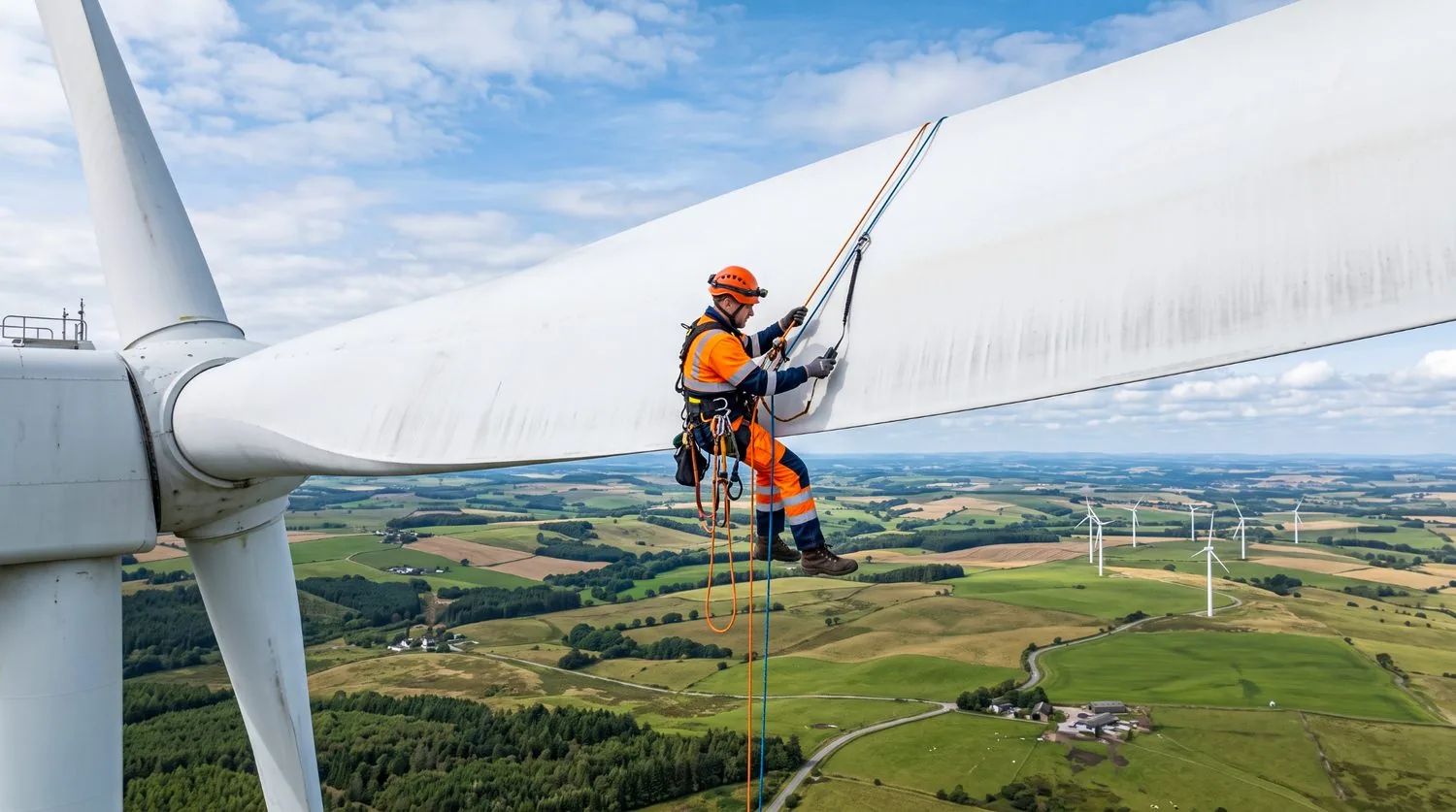
A technician performs rope-access inspection on a wind turbine blade. Life extension through routine maintenance and monitoring avoids end-of-life processing entirely. (Illustrative image.)
Extending service life. The paper treats life extension as the most environmentally sound option where it is feasible, since it avoids waste processing altogether. According to the authors, this depends on blade design tuned to local wind conditions, predictive maintenance, and careful assessment of a turbine's remaining useful life. They describe work using SCADA operational data — power output, rotor speed, nacelle and component temperatures — to forecast which parts are most likely to fail. In one case the review cites, the rear bearing on the generator stood out as the weakest link, its running temperature diverging most sharply from what the model predicted. The authors also point to standards such as DNV-ST-0262 and IEC 61400-28 for fatigue assessment, while noting a practical tension: the methods lean toward caution, in part because OEMs are reluctant to share the fine detail of their strength margins.
Upcycling and second life. Here the review covers reselling working components and repurposing whole blade sections. On resale, the authors report that Germany and Denmark account for a large share of second-hand component sales, with a small fraction held as spare parts and the rest sent onward to other waste routes. On repurposing, they describe blade segments being cut down — often by water jet — into pedestrian bridges, urban furniture, playground structures, and highway signage.
Recycling. The third family covers mechanical, thermal, and chemical processing to recover fibre, resin fractions, or energy. This is where most of the paper's technical comparison sits, and where the central trade-off lives.
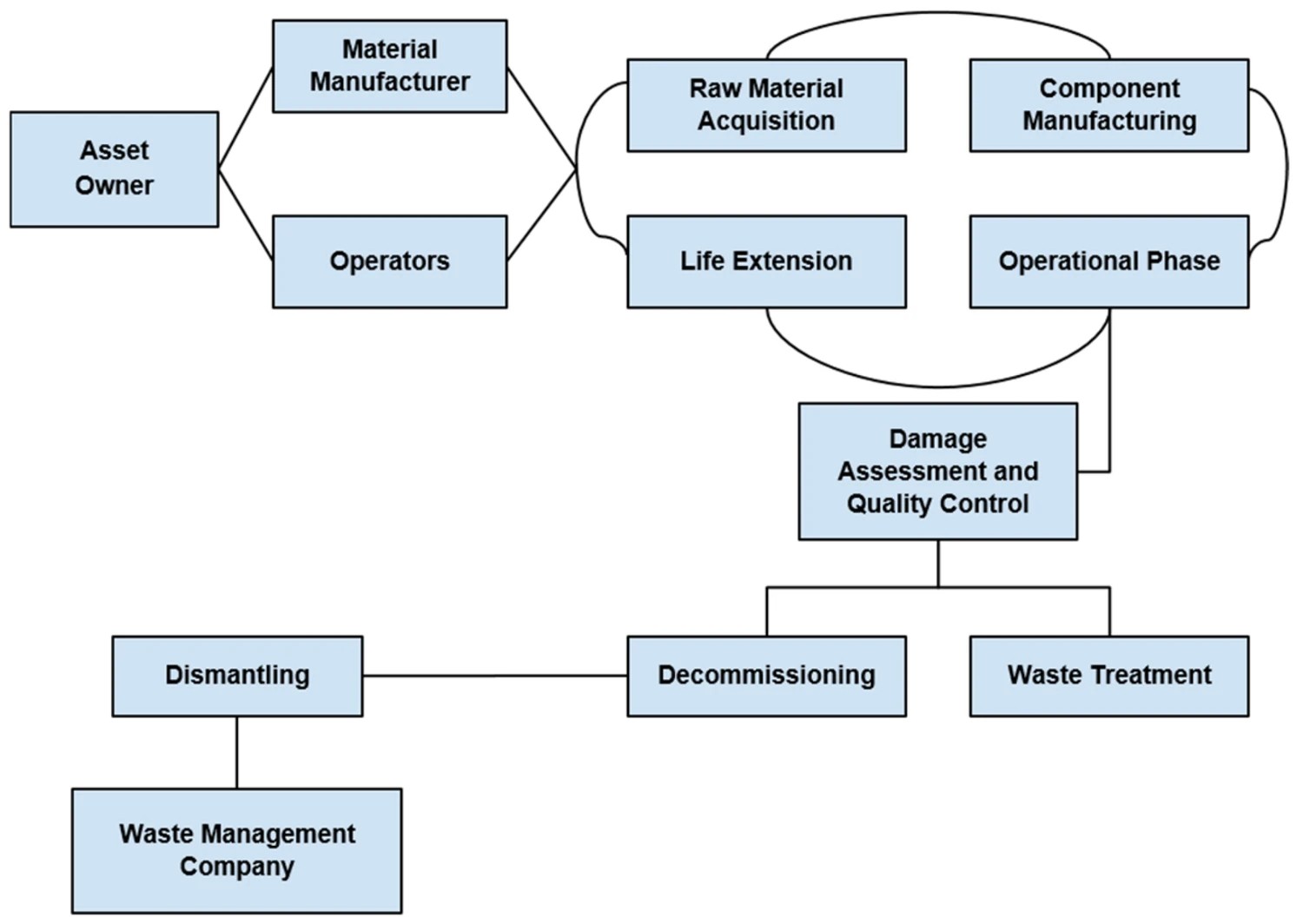
The wind turbine lifecycle as a connected system — from raw material acquisition and component manufacturing through the operational phase, life extension, and damage assessment, down to decommissioning, dismantling, and waste treatment — showing where reuse, remanufacturing, and recycling can feed material back into the loop. Figure 1 from: Cieślewicz, N.; Pilarski, K.; Pilarska, A.A. "End-of-Life Strategies for Wind Turbines: Blade Recycling, Second-Life Applications, and Circular Economy Integration." Energies 2025, 18, 5182. https://doi.org/10.3390/en18195182 — © 2025 by the authors. Licensed under CC BY 4.0 (creativecommons.org/licenses/by/4.0/).
The trade-off at the heart of blade recycling
The review's most useful contribution, in our view, is that it puts the recycling routes side by side on the same terms. The pattern it describes is consistent: the more you spend in energy and capital, the cleaner the fibre you get back.
Based on the values compiled in the paper, mechanical recycling draws the least power of any route but hands back the lowest-grade output. Pyrolysis sits in the middle. Chemical routes recover near-virgin fibre but demand the most energy and the tightest process control.
Cieślewicz, Pilarski & Pilarska (2025) · process energy, MJ per kg of composite
Process energy vs. recovered-fibre quality
Ranges as reported in the review — the cleaner the recovered fibre, the more energy the route costs.
Solvolysis, supercritical fluid, and electrochemical routes: energy not robustly reported ("NR" in the paper), grouped with chemical routes — very clean fibre, high cost.
The authors are explicit that this energy figure is only part of the story. For thermal and chemical routes, emissions control and solvent recovery are not optional extras — they are built-in parts of the process that shift the real energy and cost balance. The review calls for future studies to report abatement energy alongside yield so that routes can be weighed on equal footing.
Deployment maturity tells a parallel story. The paper attaches an indicative Technology Readiness Level (TRL) to each route, and the higher-quality methods are generally the least proven at scale.
Cieślewicz, Pilarski & Pilarska (2025) · indicative TRL bands, Table 1
Deployment maturity by route
TRL 1–9. The review lists pyrolysis both on its own and under the broader "thermal recycling" heading, so the two share the same 6–8 band.
Read together, the two diagrams capture the paper's core message: the routes that recover the best material are the ones furthest from commercial readiness, while the routes that are ready today either downcycle the fibre or destroy it for energy.
Carbon fibre versus glass fibre
This is the distinction we think deserves more attention than it usually gets, and the review supplies the evidence for it.
Most of the blade-waste conversation is really a glass fibre conversation. GFRP dominates the tonnage, and it is the material that behaves worst in recovery. The review reports that neither standard pyrolysis nor the fluidised-bed route copes well with glass-fibre composites, and that heating glass fibre to around 650°C can strip away as much as 90% of its tensile strength. Combustion recovers energy from GFRP but leaves no fibre behind.
Carbon fibre (CFRP) sits on the more favourable side of the same processes. As the review documents, by mass pyrolysis reclaims somewhere around 75.8–77.5% of the carbon fibre, and that fibre holds on to part of its mechanical performance; the fluidised-bed route can recover carbon fibre too, where it cannot for glass.
Cieślewicz, Pilarski & Pilarska (2025) · end-of-life behaviour by fibre type
Carbon fibre recovers; glass fibre mostly doesn't
As reported in the review.
- Pyrolysis yield 75.8–77.5% by mass
- Fluidised bed: feasible
- Properties partly retained
- Pyrolysis: low fibre quality
- Fluidised bed: unsuitable
- Up to ~90% tensile loss at 650°C
- Predominant blade reinforcement
Carbon fibre also starts from a higher intrinsic material value than glass, which is part of why its recovery economics differ. This observation is ours, not the paper's.
The pyrolysis mass balance the paper reports helps explain why carbon fibre recovery is attractive: the process yields not just fibre but usable oil and gas fractions as well.
Cieślewicz, Pilarski & Pilarska (2025) · pyrolysis of blade composite, 400–600°C anaerobic
Pyrolysis mass balance
100 kg of composite in — carbon fibre out, plus recoverable oil and gas fractions. Optimal process temperature ~550°C.
For manufacturers producing CFRP blade components — which is where AFP is typically used — this split matters commercially, not just environmentally. Carbon fibre has both a higher starting value and a genuinely established thermal recovery route, so the end-of-life economics of a CFRP part are a different conversation from the glass-fibre- dominated blade-waste story that drives most headlines. We think that is worth separating out explicitly when discussing recovery strategy, rather than folding carbon fibre into a general "blades are unrecyclable" narrative.
Second life: promising, but not proven
The review is refreshingly candid about repurposing, and we want to preserve that honesty rather than sand it down.
On the positive side, the paper reports a striking example from the United States: a study by Ramaswamy and colleagues (2025) built a prototype highway sign about 12 m across that used roughly three tonnes of decommissioned blade. Measured against an equivalent conventional sign, the team reported cutting steel by some 2,041 kg and concrete by 9.14 m³ — on the order of 73% less material, and 242 tonnes of CO₂ avoided.
But the review does not oversell it. According to the authors, blade fragments repurposed into pedestrian bridges and similar structures have only been in service for a handful of years, so long-term durability data simply does not exist yet. How these structures hold up to season-by-season weathering is still largely unexamined. And reused blade parts frequently sit outside the codes and specs engineers rely on — a gap the authors see as a genuine brake on professional uptake. They point to structural-integrity monitoring frameworks — for example the acoustic-emission testing described by Johst and colleagues (2025) — as a route toward making these applications engineering-credible.
The paper also surveys where recovered blade material is actually being used across sectors:
Cieślewicz, Pilarski & Pilarska (2025) · sectors mapped in the review
Where blade material goes
Construction is emerging as the main destination — mostly through open-loop routes that accept some loss of quality in exchange for a low-energy outlet.
What is actually running at industrial scale
The review distinguishes pilot-stage promise from genuine industrial activity, and it names concrete examples. We are reporting these as the paper presents them.
The authors describe the ZEBRA consortium, in which LM Wind Power and Arkema have built full-size demonstrator blades — roughly 62 and 77 metres — from Elium resin, and have publicly shown those laminates being reprocessed back into usable material in a closed loop. They also point to Siemens Gamesa's RecyclableBlade, which went into service at RWE's Kaskasi site in 2022 and has since won follow-on orders, the Sofia project among them — early but real commercial uptake for blades designed for chemical recovery.
For carbon fibre specifically, the review cites Carbon Conversions, which runs a plant built specifically for CFRP: it takes in a steady flow of carbon-fibre offcuts and channels the reclaimed fibre back out to commercial buyers. And for high-volume glass fibre, it points to cement-kiln co-processing within large cement groups including Holcim/Geocycle, where shredded blade composite substitutes for both fuel and raw material. The authors are clear that co-processing recovers no continuous fibre, but they credit it as a route that can absorb large volumes of glass-fibre waste quickly and in many locations.
By contrast, the paper places solvolysis and supercritical routes mostly in the pilot-to-demo bracket (around TRL 4–6). Scaling them into continuous plants, the authors argue, depends on closing the solvent loop, recovering process heat, and agreeing trusted fibre-quality grades.
Regulation, markets, and money
The final third of the review argues that technology alone will not close the loop — a point we find well supported. The authors situate blade recycling inside circular economy frameworks and lay out the policy and finance instruments that would turn pilots into bankable projects.
They distinguish closed-loop recycling (material returning to the same product cycle) from open-loop recycling (material moving to another sector, such as construction). For blades today, the authors note, nearly all of it is open loop — a result of how much fibre quality is lost in processing, and of how hard it is to route recovered composite back into new blades. The paper then maps cost per tonne against deployment status, making the economic logic visible.
Cieślewicz, Pilarski & Pilarska (2025) · €/t at plant gate, EUR-2024
Indicative cost per tonne
The cheap routes are ready today; the routes that recover the best fibre are still expensive and largely unproven at scale.
* a gate fee received by the operator can offset processing cost.
To bridge the gap between the cheap-but-low-value routes and the expensive-but-high-value ones, the authors propose a coordinated policy toolkit: harmonised end-of-waste criteria and quality grades across the EU; a sector-specific Extended Producer Responsibility (EPR) scheme covering blades, with fees tuned so that easy-to-dismantle designs and recyclable resin systems pay less; procurement rules that set a floor on recycled fibre in public projects; product passports; and a bloc-wide register tracking blades as they are retired. Their broader argument is that price signals need to reach the design stage, so that upstream choices about resins and architecture are made with recovery in mind.
Where Addcomposites fits
Everything below is Addcomposites' own analysis, not a view attributed to the paper's authors.
We spend our days on the manufacturing end of the blade lifecycle — the point the review identifies as decisive for whether recovery is even possible. The paper's repeated call to embed design-for-recycling early, to limit mixed resin systems, and to favour architectures that can be taken apart is, from where we sit, a manufacturing conversation as much as a policy one. How a part is laid up shapes how cleanly it can later be recovered.
Two things follow for the manufacturers we work with.
First, end-of-life is becoming part of the sales conversation, not an afterthought. Blade OEMs and operators increasingly ask suppliers to show a credible materials strategy, not just a quality record. A review like this one is useful precisely because it is honest about the gaps — lab-scale chemical routes, missing durability data for repurposed structures, recycling capacity lagging waste volumes. Referencing the real state of the field, gaps included, tends to land better with sustainability-minded customers than an optimistic recyclability claim that does not survive scrutiny.
Second, the carbon fibre advantage is worth stating plainly. As the review documents, CFRP has established thermal recovery routes and retains more value than GFRP through end of life. For teams building CFRP components, that is a genuine point of differentiation in the circularity discussion.
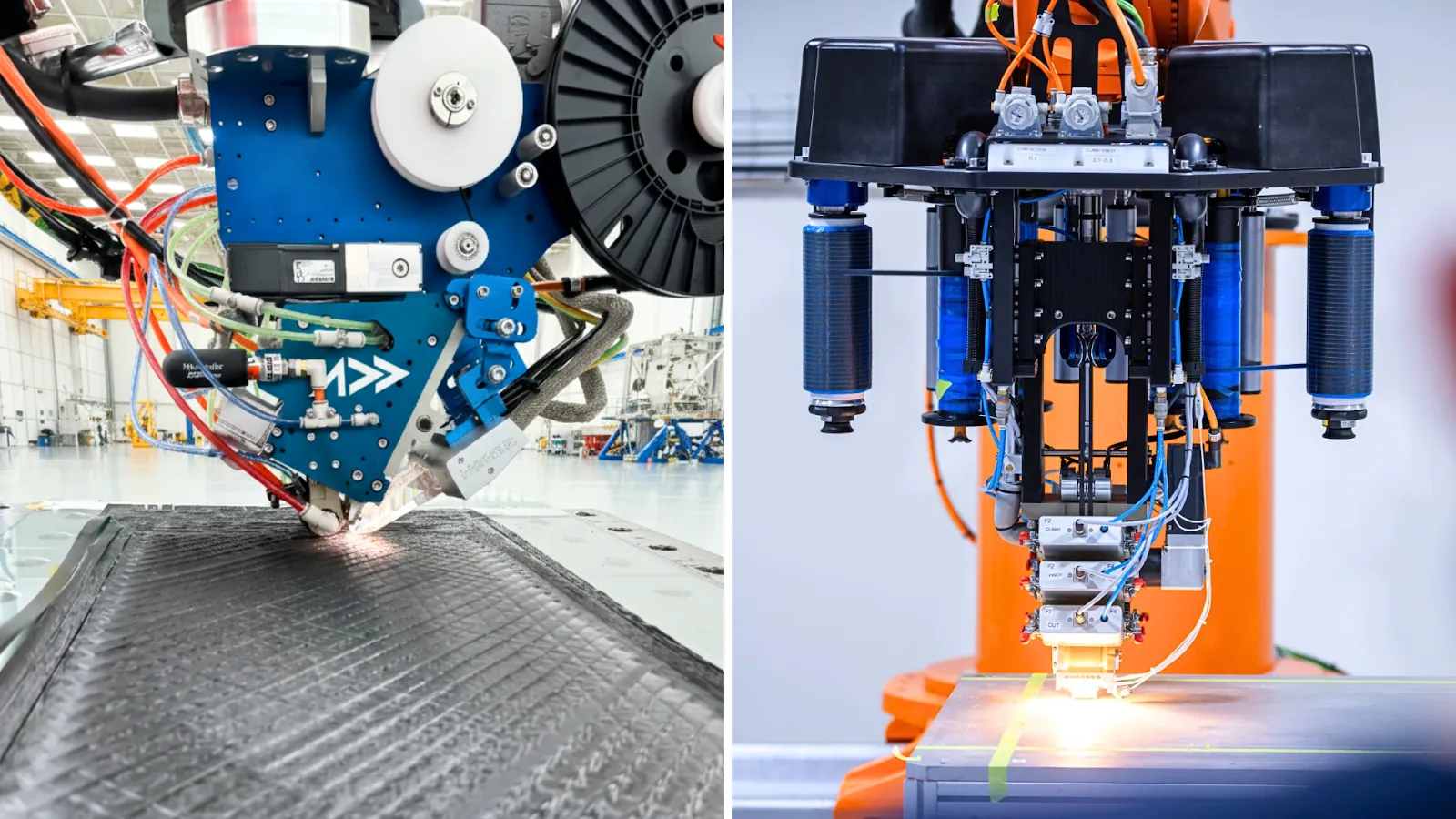
Addcomposites AFP-XS (left) and AFP-X (right) laying carbon-fibre tow onto a mould. Precise, repeatable layup is the foundation of well-characterized composite parts.
Our AFP systems are built to make those components well in the first place: AFP-XS is our accessible entry point into automated fibre placement, pairing with our AddPath software for path planning and in-process quality control, while AFP-X, our four-tow system, targets higher deposition rates on intricate, higher-volume structures. Clean, repeatable layup with tight process control is not only a quality story during manufacturing — it also produces the kind of consistent, well- characterised parts that downstream recovery and reuse depend on.
We are not claiming AFP solves blade recycling. The review makes clear that no single technology does. But the manufacturing decisions made at the start of a blade's life set the ceiling on what is recoverable at the end of it, and that is where automation, precision, and design-for-recovery meet.
If your team is thinking through a CFRP blade component's materials strategy — from layup quality through to what happens at end of life — get in touch with the Addcomposites team →
Contact Us for a ConsultationThe bottom line
The Energies review lands on a deliberately modest conclusion: no single method will solve blade recycling on its own. Life extension avoids the problem where it can. Mechanical recycling and cement co-processing are ready today but downcycle or destroy the fibre. Chemical routes recover near-virgin material but remain costly and largely unproven at scale. Second-life repurposing is promising but under-standardised. Progress, the authors argue, will come from combining better technology with coherent regulation, market-creation instruments, and design choices made with recovery in mind.
For AFP manufacturers, the useful reframing is this: the blade-waste crisis is overwhelmingly a glass fibre crisis, and carbon fibre sits on the more recoverable side of it. That is a distinction worth carrying into every conversation about where the fibre goes when the blades come down.
Read the research
This article summarizes and comments on independent academic work. All technical findings belong to the original authors. We encourage you to read the open-access paper in full:
- Cieślewicz, N.; Pilarski, K.; Pilarska, A.A. "End-of-Life Strategies for Wind Turbines: Blade Recycling, Second-Life Applications, and Circular Economy Integration." Energies 2025, 18, 5182. https://doi.org/10.3390/en18195182 Published open access 29 September 2025 by MDPI. © 2025 by the authors. Licensed under the Creative Commons Attribution (CC BY 4.0) license: https://creativecommons.org/licenses/by/4.0/
The authors have not reviewed or endorsed this article, Addcomposites, or its products.