

ADDCOMPOSITES BLOG
What If the Airframe Itself Was the Battery? A Structural Power Composite Could Double an Air Taxi's Cruise Endurance
A 2023 study sizes structural power composites for a four-seat eVTOL: at 54 GPa, 203 MPa, 74 Wh/kg and 376 W/kg the airframe stores the energy, cruise endurance roughly doubles, and the battery pack becomes payload.
Every electric aircraft carries two kinds of mass that fight each other. There is the structure that has to hold the vehicle together, and there is the battery pack that keeps it flying. On a conventional design, the battery is dead weight to the airframe and the airframe is dead weight to the battery. Neither helps the other do its job. A 2023 open-access study in the Journal of Composite Materials asks a deceptively simple question: what happens if those two masses become one and the same part?
The answer, according to the analysis, is striking. Holding the power source's specific energy fixed, an air taxi built around structural power composites (SPCs) could roughly double its cruise endurance compared with the same vehicle carrying conventional batteries, and swapping all eligible structure and batteries for SPC material could cut the vehicle's total weight by about a quarter.
This post walks through what the paper actually modelled, what performance numbers a structural power composite would need to hit, and where the concept still faces hard engineering problems. Throughout, we keep a clear line between what the study reports and where Addcomposites adds its own commentary.
About the source. The findings below come from Aneesa Ishfaq, Sang N. Nguyen, Emile S. Greenhalgh, Milo S. P. Shaffer, Anthony R. J. Kucernak, Leif E. Asp, Dan Zenkert and Peter Linde, "Multifunctional design, feasibility and requirements for structural power composites in future electric air taxis," Journal of Composite Materials, 2023, Vol. 57(4), 817–827. The work was carried out by teams at Imperial College London, Chalmers University of Technology, KTH Royal Institute of Technology and the German Aerospace Center (DLR). Full citation and DOI are at the end.
What a structural power composite actually is
Start with the terminology, because it matters. A structural power composite is not a battery bolted onto a composite panel, and it is not a battery buried inside a laminate as a passenger. The paper draws a sharp distinction here: in a genuine SPC, the individual constituents each do more than one job at once. The carbon fibres that give the laminate its stiffness are the same fibres that store and move electrical charge. Because the same material is pulling double duty, more of every kilogram is doing two jobs instead of one, and that is where the savings in both mass and volume come from. That integration is also exactly what makes SPCs harder to build than a laminate with a separate embedded cell.
Two device families share this idea. A structural battery composite (SBC) banks charge in chemical bonds, so it holds a lot of energy per kilogram but is slower to give it back and wears out sooner with repeated cycling. A structural supercapacitor composite (SSC) moves charge physically rather than chemically, which lets it deliver and soak up power in bursts and survive many cycles, at the cost of storing far less energy in the same weight. The paper notes that both can be built into the same laminated stack: two electrodes on either side of a separator that blocks electrons but lets ions through, all held together by a structural electrolyte.
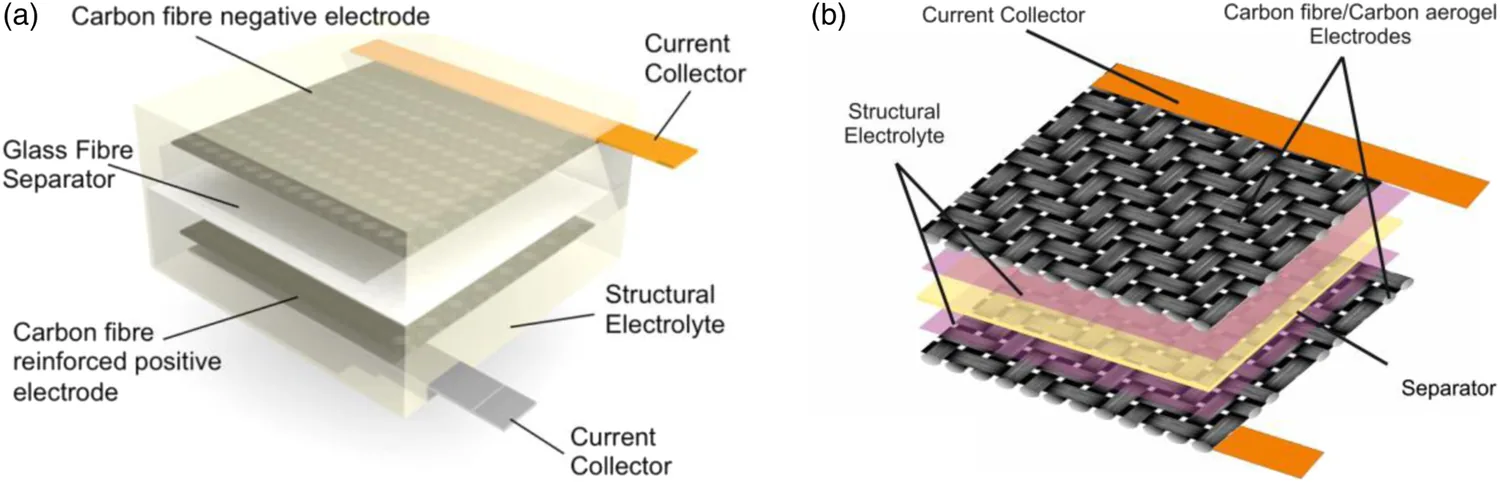
The paper is candid that the structural electrolyte is one of the hardest parts of the whole technology. It has to shuttle ions and hold a mechanical load at the same time, and those two demands tend to work against each other. The authors describe how researchers have modified common composite matrices such as epoxies and vinyl esters, added lithium salts for modest gains, and then moved toward blending in ionic liquids and battery electrolytes to create an interpenetrating two-phase network that can be tuned between mechanical and electrochemical performance. The catch is manufacturing: the liquid phase can interfere with how the polymer cures, and the two phases can separate in ways that wreck the ideal microstructure.
The electrodes differ between the two device types. In a structural battery, PAN-based carbon fibres act as the negative electrode by taking lithium ions into their microstructure during charging, while on the positive side the fibres do triple duty at once: structural reinforcement, the current path, and the framework that carries the cathode particles. In a structural supercapacitor, the priority is surface area, and bare carbon fibre has almost none, so the field has experimented with chemical activation, nanocarbon grafting, conductive-polymer or metal-oxide coatings, and carbon aerogel infusions to raise capacitance without destroying the fibre's mechanical role.
One detail worth flagging for anyone thinking about manufacturability: in an ordinary cell, the electrode sits on a metal foil that carries the current, and that foil alone can make up a quarter of the cell's weight. The paper points out that an SPC does not need the foil to cover everything, so designs using only partial metal coverage can shed a real slice of that parasitic mass.
The test vehicle: a four-seat eVTOL
To turn these ideas into numbers, the study needed a concrete aircraft, and it chose the Airbus CityAirbus as its reference. It is an all-electric, wingless eVTOL with eight propellers driven by eight motors, sized to carry four occupants, and it has already flown as a full-scale demonstrator, which gave the authors enough available data to work with.
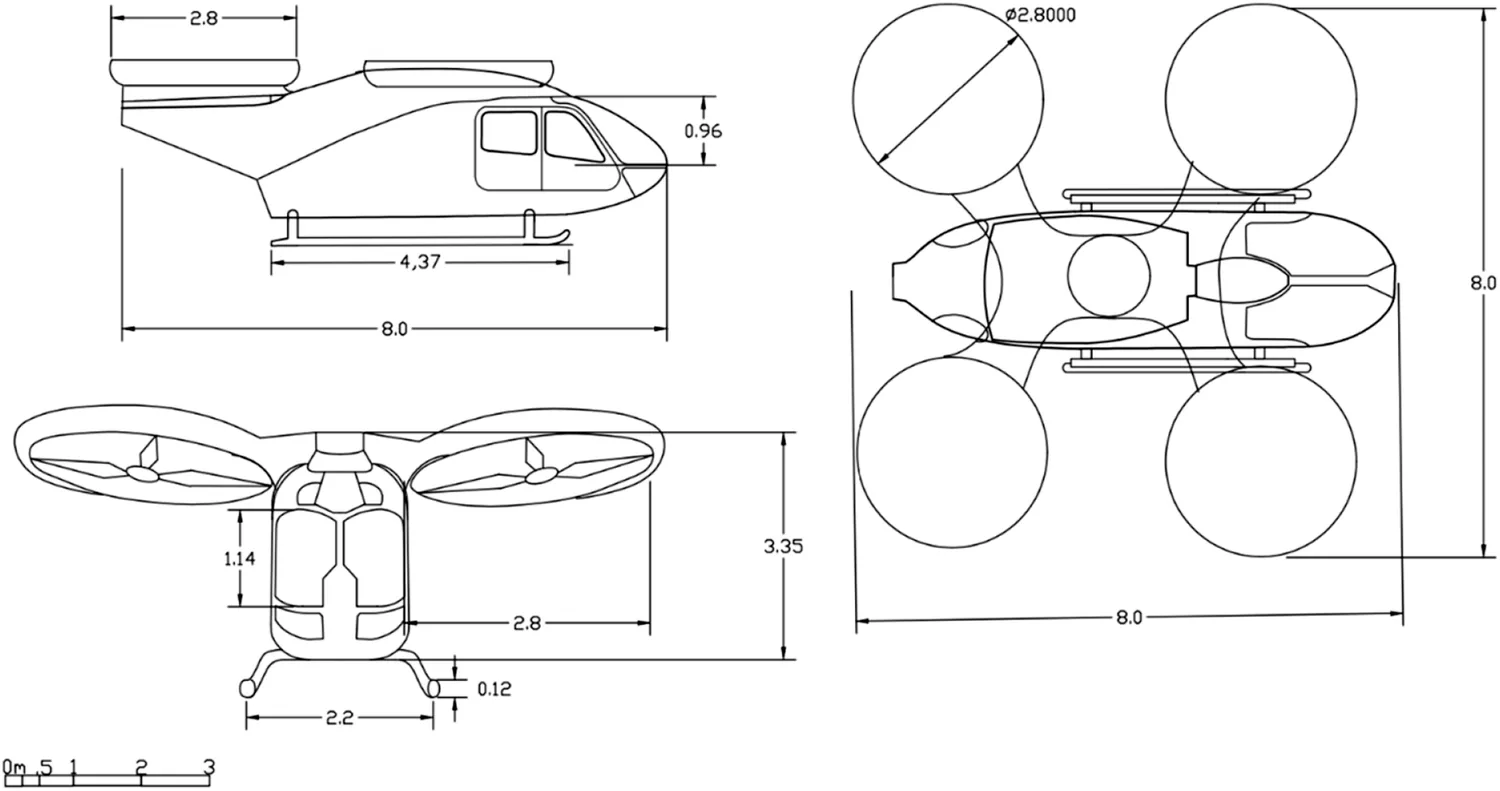
The vehicle's baseline specification, as used in the study, looks like this:
ISHFAQ ET AL. 2023 · REFERENCE VEHICLE
CityAirbus baseline, as modelled
The four-seat, all-electric eVTOL the study sized its structural power composite against.
2450 kg
Max take-off weight
2200 kg
Empty operating mass
250 kg
Payload
110 kWh
Total battery energy
15 min
Max endurance
120 km/h
Cruise speed
8 / 8
Propellers / motors
2.8 m
Propeller diameter
Data source: Ishfaq et al., J. Compos. Mater. 2023, 57(4), 817–827, drawing on the CityAirbus specification. https://doi.org/10.1177/00219983221132621 (CC BY 4.0).
The authors built a nominal 15-minute mission profile and worked out the energy and power each flight segment demands. Hovering draws the most power, so it sets the peak, and because the aircraft spends more time cruising than in any other phase, cruise ends up eating the biggest share of the energy. To keep the results honest, the study ran Monte Carlo simulations that let uncertainties in segment durations, masses and system efficiencies propagate through the calculations rather than assuming everything is exact.
The mission analysis produced two numbers worth remembering. The calculated energy for the baseline mission came out around 68 kWh (with roughly an 8% uncertainty band), well under the 110 kWh the actual battery holds. That gap reflects a deliberate reserve, an energy reserve factor of about 1.62, covering reserve-mission requirements and battery-longevity margins. On the power side, the calculated peak of about 172 kW sat far below the roughly 560 kW the battery can deliver, implying a power reserve factor north of three. The study treats these healthy margins as a sign that its demand estimates are reasonable rather than aggressive.
Where the replaceable mass hides
A structural power composite can only earn its keep if there is enough of the airframe it can plausibly become. So the study performed a mass audit of the CityAirbus, deciding which components could reasonably be rebuilt from SPC.
Not everything qualifies. Motors, avionics, wiring and similar hardware stay as they are. The candidates are the structural pieces that would otherwise be conventional carbon fibre reinforced polymer, plus the battery mass the SPC could displace. Importantly, the authors did not assume the whole structure becomes live material. In their layup, the load-bearing SPC plies are wrapped in protective monolithic CFRP, roughly twenty plies of structural power material sandwiched between two CFRP plies on each face, which works out to about 83% of the composite mass being active SPC.
After that adjustment, the picture of the take-off weight looks like this:
Ishfaq et al. 2023 · Mass audit
Where the take-off mass goes
Audit total 2477 kg, about 1% above the 2450 kg nominal MTOW. Red = mass a structural power composite can replace.
Eligible for SPC replacement
939 + 550 = 1,489 kg — about 60% of MTOW
That is about 2.7 times the mass of the batteries alone.
Data source: mass breakdown reported in Ishfaq et al., J. Compos. Mater. 2023, 57(4), 817–827. https://doi.org/10.1177/00219983221132621 (CC BY 4.0). Bars are an Addcomposites-created visualization of the study's figures.
That 1489 kg total is the crux of the whole argument. The mass available to store energy in an SPC design is about 2.7 times the mass of the batteries alone. Give the aircraft that much more material to hold charge in, and the specific energy each kilogram must provide drops sharply. This is the lever the rest of the study pulls.
The numbers an SPC would have to hit
The structural analysis kept things deliberately conservative. Rather than model the entire airframe, the authors zeroed in on the floor panels, which they expected to see the worst combination of compression and bending loads and which are limited by stiffness because of the risk of buckling. Treating those panels as honeycomb-cored sandwich structures and applying established buckling and bending relations, they derived the minimum mechanical properties an SPC would need, then folded in a 5% error margin for safety.
Putting the structural minimums together with the electrochemical minimums gives the headline target. To match the CityAirbus's current design performance while keeping the vehicle's weight unchanged, the study finds an SPC would need roughly:
- Elastic modulus: at least 54 GPa
- Strength: at least 203 MPa
- Specific energy: at least 74 Wh/kg
- Specific power: at least 376 W/kg
How does that compare with what has actually been built in a lab, and with the conventional materials it would replace? This is where the technology's current gap becomes visible:
ISHFAQ ET AL. 2023 · REQUIRED PROPERTIES
The target versus what has been built
Red is what an SPC needs for the CityAirbus mission. No single device reaches it on energy and power at once.
Specific energy · Wh/kg
Specific power · W/kg
Elastic modulus · GPa
Data source: values compiled from Ishfaq et al., J. Compos. Mater. 2023, 57(4), 817–827 — the SOTA and Li-ion/CFRP figures from Table 5, the 74 Wh/kg and 376 W/kg targets from Table 4 (Case A, 100%), and the 54 GPa and 203 MPa structural minimums from the structural analysis (p. 823). https://doi.org/10.1177/00219983221132621 (CC BY 4.0). Bars are an Addcomposites-created visualization; SOTA structural battery figures reference Asp et al. and SOTA supercapacitor figures reference Pernice et al. and Greenhalgh et al. as cited in the source paper.
Two things jump out. First, no single device type currently reaches the target on both energy and power at once: the best structural batteries store useful energy but deliver almost no power, while the best structural supercapacitors deliver power but store almost no energy. Second, and more encouraging, the target itself is not wildly out of reach. The study's own read is that the best structural power composites built so far are closing in on what the air taxi would demand, which is why the authors judge adoption feasible rather than fanciful.

Why the endurance roughly doubles
The most quotable result in the paper is the endurance comparison, and the mechanism behind it is worth understanding rather than just repeating.
The study modelled three scenarios. In Case A, SPCs replace a share of the eligible mass while the take-off weight is held at the baseline 2450 kg, so the mission's energy and power demands stay fixed. In Case B, all eligible composites and batteries become SPC, letting the total weight fall as the design varies the material's structural efficiency. In Case C, the study compares cruise endurance for a battery-powered CityAirbus against an SPC-powered one across a wide range of specific-energy values.
Case A shows how forgiving the requirement becomes when more of the aircraft is doing electrochemical work. Because the required specific energy and power scale inversely with how much of the eligible mass is converted to SPC, using the full eligible mass drives the requirement down dramatically:
ISHFAQ ET AL. 2023 · CASE A, TAKE-OFF WEIGHT HELD AT 2450 KG
Case A: the more airframe that stores energy, the less each kilogram must store
Required SPC properties against the share of the 1,489 kg eligible mass converted to SPC.
| Share converted | SPC mass | Required Γ* (Wh/kg) | Required P* (W/kg) |
|---|---|---|---|
| 20% | 298 kg | 369 | 1,880 |
| 40% | 596 kg | 185 | 940 |
| 60% | 893 kg | 123 | 627 |
| 80% | 1,191 kg | 92 | 470 |
| 100% | 1,489 kg | 74 | 376 |
Data source: Case A results in Ishfaq et al., J. Compos. Mater. 2023, 57(4), 817–827 (Table 4), for the 100% structural-efficiency case. https://doi.org/10.1177/00219983221132621 (CC BY 4.0).
Case C is where the doubling appears. At any given specific energy, the SPC configuration flies longer in cruise, and the reason is simply that the load-bearing structure gives roughly 70% more mass to hold charge than the battery pack did, on top of the weight savings from removing the separate pack. Less onboard weight means less energy and power needed to complete the mission, which loops back to lower the specific-energy requirement further:
ISHFAQ ET AL. 2023 · CASE C
Same specific energy, roughly double the cruise
Schematic of the study's trend, drawn through its route example: at any given specific energy, SPC endurance is roughly double.
For a 240 km London–Manchester hop at the CityAirbus cruise speed, batteries would need about 370 Wh/kg; an SPC about 170 Wh/kg — 54% lower.
Data source: cruise-endurance comparison in Ishfaq et al., J. Compos. Mater. 2023, 57(4), 817–827 (Figure 4 trend). https://doi.org/10.1177/00219983221132621 (CC BY 4.0). This is an Addcomposites-created sketch of the reported relationship, not a reproduction of the paper's figure.
The authors make the payoff concrete with a route example. Imagine a 240 km hop, roughly London to Manchester, flown at the CityAirbus cruise speed of 120 km/h for a two-hour cruise. Batteries would have to reach around 370 Wh/kg for that flight; an SPC could manage the same trip at roughly 170 Wh/kg, a little under half as much (a 54% lower requirement). Put differently, the battery route would require close to double the specific energy of the CityAirbus's actual pack-level batteries, while the SPC route stays within a more plausible envelope.
There is also a payload story in Case A. Because a 74 Wh/kg, 376 W/kg SPC stores the mission's energy in the structure itself, the 550 kg of batteries can be removed while take-off weight stays at 2450 kg, freeing that mass for extra payload and making a four-seat air taxi meaningfully more commercially useful.
The honest list of what still has to be solved
To its credit, the study spends real space on the obstacles, and any credible discussion of SPCs has to sit with them rather than skip past.
The hardest technical problem is meeting the specific-energy and specific-power targets simultaneously with one device type. The authors expect stiffness and energy density to be the nearer-term wins for structural batteries, with power density the laggard, and they float the idea of pairing batteries with supercapacitors to handle the power peaks in the meantime. Because supercapacitors have simpler electrochemistry, they can also serve as a testbed for solving the generic scale-up problems that batteries share.
Maintenance is a genuinely awkward issue. A conventional battery can be swapped out for a better one at end of life. A structural battery is part of the airframe, so damage may mean a structural repair rather than a module change, with the cost implications that carries. That pushes fatigue life and damage tolerance to the front of the queue, and those in turn are tied to crashworthiness, an area the study explicitly did not analyse for lack of impact-test data. There are also the environmental and safety questions any aircraft material faces: resistance to flight conditions (which may require external CFRP protection anyway), and how it behaves in a fire: smoke generation, toxic emissions and flammability. Finally, the authors flag the unglamorous but decisive matter of charging infrastructure, fast-charge capability and port placement, since an air taxi's economics depend on how quickly it can turn around between short hops.
ISHFAQ ET AL. 2023 · MATURITY SNAPSHOT
How mature structural power is today
Both device families exist in the lab. Neither yet does both jobs at airframe scale.
Structural supercapacitors
Demonstrated at TRL 4
Component validation in the lab. Demos include an automotive boot lid and a fuselage rib actuating a desktop-scale model of an aircraft door.
Structural batteries
Multicell laminate demonstrated
Gap to target
Energy + power together
In one device, at airframe scale.
Data source: technology-readiness and demonstrator details in Ishfaq et al., J. Compos. Mater. 2023, 57(4), 817–827. https://doi.org/10.1177/00219983221132621 (CC BY 4.0).
Where this connects to how the part gets built
Everything above is the study's contribution. The following is Addcomposites' own reading of what it means for people who will eventually have to manufacture these parts.
The demonstrator SPCs cited in the literature have often been built by hand, in some cases inside a glovebox. That is fine for proving a concept, but it does not scale to airframe-sized parts with consistent, inspectable quality. A programmable AFP process places each tow along a defined path, ply after ply, the same way every time, and captures what it did as it goes.
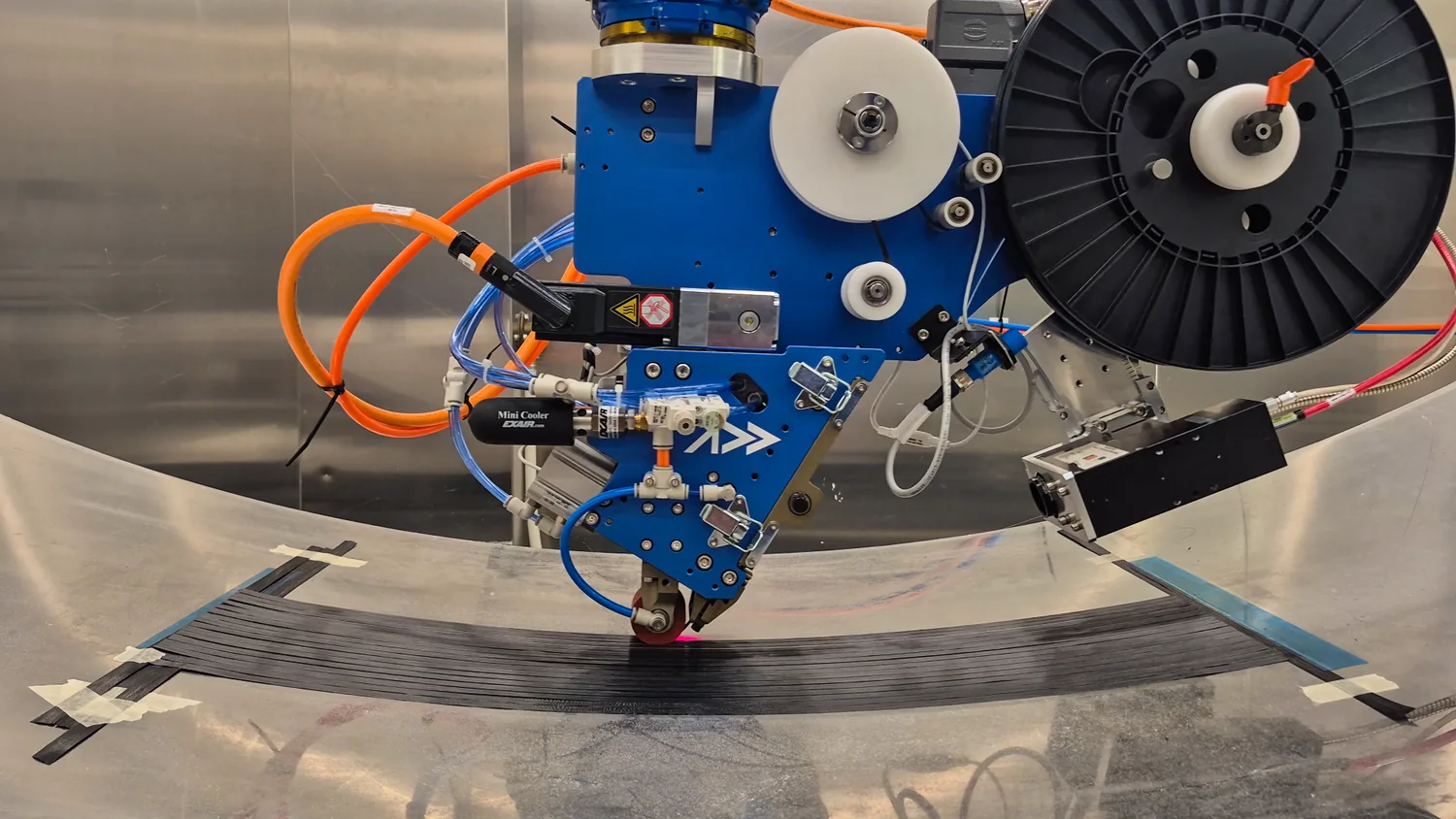
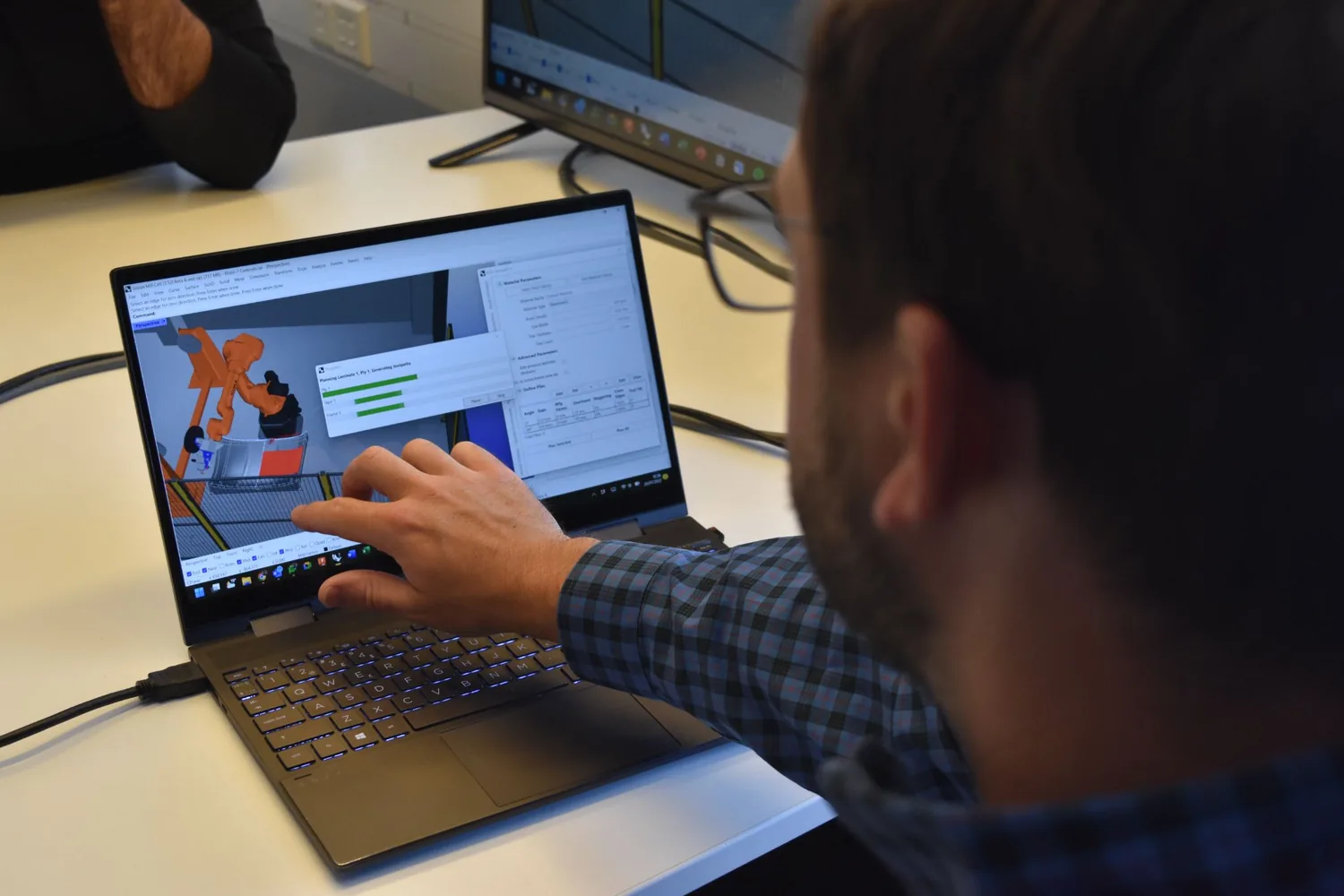
None of this shortens the road the study lays out. The chemistry still has to mature, the power target still has to be met, and certification still has to be earned. But if and when structural power composites do move from bench demonstrators toward real airframes, the deciding factor between a lab curiosity and a certifiable part will be whether the laminate can be laid down precisely, repeatably and at scale. That is a manufacturing question, and it is worth getting ahead of now.
The bottom line
The study's contribution is not a new material; it is a clear-eyed set of targets. By fixing on a real four-seat eVTOL and working the energy, power and structural budgets end to end, the authors show that a structural power composite reaching roughly 54 GPa, 203 MPa, 74 Wh/kg and 376 W/kg would let an air taxi keep its weight, double its cruise endurance at the same specific energy, or trade its battery pack for hundreds of kilograms of extra payload. State-of-the-art SPCs are not there yet, especially on power, but they are close enough that the authors judge the concept feasible for urban air mobility rather than speculative, leaving the field a concrete set of targets to build toward.
Read the Research
Aneesa Ishfaq, Sang N. Nguyen, Emile S. Greenhalgh, Milo S. P. Shaffer, Anthony R. J. Kucernak, Leif E. Asp, Dan Zenkert and Peter Linde. "Multifunctional design, feasibility and requirements for structural power composites in future electric air taxis." Journal of Composite Materials, 2023, Vol. 57(4), 817–827. https://doi.org/10.1177/00219983221132621
Open access, published under a Creative Commons Attribution (CC BY 4.0) licence: https://creativecommons.org/licenses/by/4.0/
Addcomposites is the provider of an automated fiber placement ecosystem, including the AFP-XS and AFP-X systems and AddPath planning, simulation and digital-twin software. The commentary in this article reflects Addcomposites' own views and is independent of the cited research.