

ADDCOMPOSITES BLOG
Automated Fiber Placement Is Moving Beyond Aerospace: What a 2024 Review Shows
A 2024 open-access review finds AFP has moved beyond aerospace through dry-fiber and thermoplastic materials, tow steering, and smaller robot-based systems, with in-line inspection still the enabler.
If you have been waiting for a fresh, citable survey of where Automated Fiber Placement (AFP) is actually heading, a 2024 open-access review in Composites Part B: Engineering delivers one. Written by Stefan Carosella, Sebastian Hügle, Florian Helber, and Peter Middendorf at the University of Stuttgart's Institute of Aircraft Design, it deliberately takes a wide-angle view: not just AFP, but its whole technology family, including automated tape laying (ATL), Tailored Fiber Placement (TFP), and robotic and coreless filament winding.
The paper's central argument, as the authors present it, is that these automated fiber-alignment technologies have grown out of their original aerospace niche and are turning up in cars, wind turbines, sporting goods, and, more recently, building design. As we would summarize it, that spread rests on three things at once: new material classes (dry fiber and thermoplastics), the maturing of tow steering for load-optimized layups, and a shift from large gantry machines toward smaller, cheaper robot-based systems. The authors add a fourth thread, in-line quality inspection, but frame it as the enabler still needed to push composites further beyond aerospace rather than as a driver of the expansion that has already happened.
The rest of this post walks through what the review says on each of those fronts, with original diagrams built from the paper's own numbers, and clearly separates the authors' findings from our own commentary.
From tape laying to fiber placement: two related but distinct processes
The paper traces a fairly clean lineage. The authors describe the first ATL systems taking hold in the 1980s, running on computer-driven gantries that set down composite tape across flat or lightly contoured molds to build up big parts one course after another. AFP arrived in the 1990s, extending automation to continuous fiber that could be placed at a range of angles over curved surfaces.
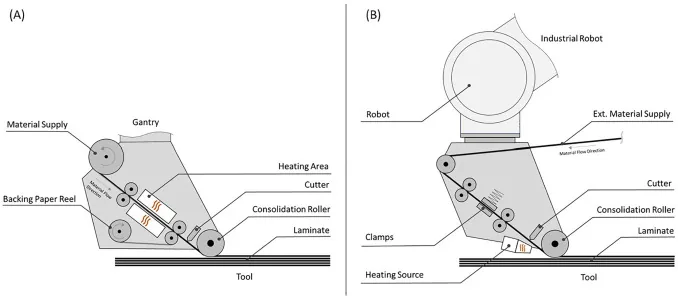
The key mechanical distinction the paper draws is material width and how the material contacts the tool. An ATL head handles a single wide prepreg tape — the authors give current widths of 75, 150, or 300 mm — and needs its material storage close to the head, which is part of why gantries became the norm. An AFP head, by contrast, gathers several narrow tows or slit tapes into one band and lays it straight onto the tool, keeping tension low while a roller presses down with a controlled force. One nicely compact point from the review: as the authors write, AFP was "originally designed to overcome the limitations of the filament winding technology."
Here is that head-level contrast, drawn from the paper's Figure 1 and the surrounding text:
Head architecture
ATL vs AFP: one wide tape or many narrow tows
How gantry-mounted tape laying and robot-mounted fiber placement differ in material feed, heating, compaction, cutting, and tool geometry.
ATL HEAD
gantry-mounted
75 / 150 / 300 mm
defined compression
flat / lightly curved
Single band, wide.
Backing paper managed on a reel.
AFP HEAD
robot-mounted
12 / 24 / 32 tows
hot gas | laser | IR | pulsed broadband
defined compaction
flat, curved, cylindrical
Band width is variable: add or drop individual tows.
Data source: Addcomposites comparison of ATL and AFP head architectures. Addcomposites-created visualization.
The band-building detail is where AFP earns its flexibility. The paper explains that each tow can be fed, halted, severed, and started again independently, which is what lets an AFP head follow complex geometry, steer tows around curves, and resize the band on the fly by adding or dropping tows.
AFP process / tow-level control
How an AFP band is assembled from independent tows
Five tows converge in the head into one consolidated band. Cutting tow 3 early and skipping tow 5 narrows the band locally, so the head can cover tapering or complex regions cleanly.
Typical tow widths: 1/4" = 6.35 mm · 1/2" = 12.7 mm
Source: Addcomposites technical reference on tow-level band assembly in automated fiber placement. Addcomposites-created visualization.
The material shift: prepreg, dry fiber, and thermoplastics
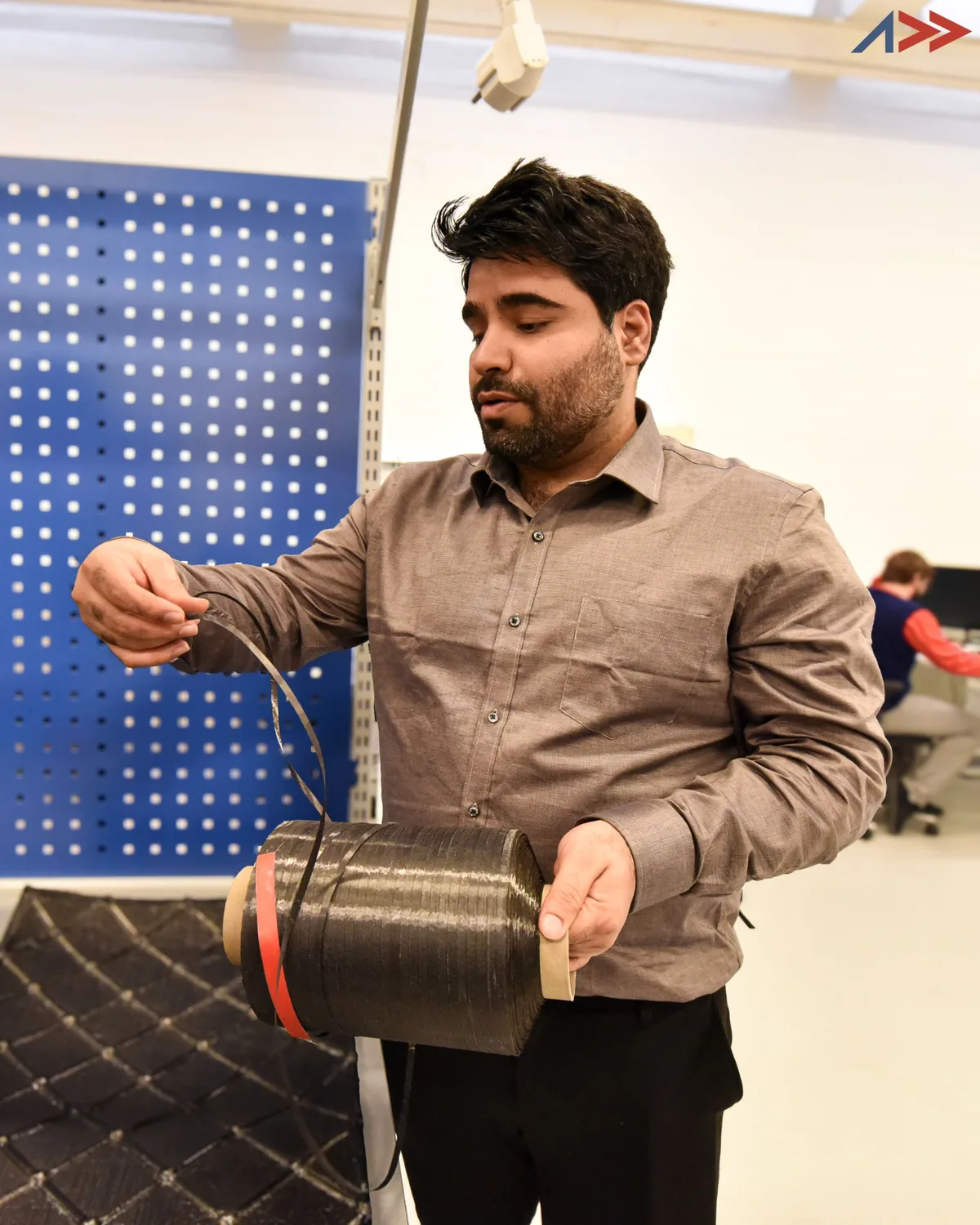
Much of what makes the 2024 review feel current is its treatment of materials. The authors sort AFP feedstock a few ways: towpregs and slit prepreg tapes that arrive already impregnated with resin, dry fibers that carry none, and thermoplastic tapes — and they are candid about the trade-offs of each.
AFP material families
Three material families, three different sets of problems
How the review characterizes prepreg slit tape, dry fiber and thermoplastic tape for automated fiber placement.
Prepreg slit tape
Well established
Still the go-to material for aerospace parts. The incumbent route: the resin is already in the tape, so plies tack down and stay where the head puts them.
Dry fiber (DFP)
Gaining focus
Dry fabric has no natural stickiness, so binders are added to anchor plies and hold the layers together. The binder is what makes a dry layup survive handling and shaping before infusion.
Thermoplastic tape
Re-meltable & weldable
Can be re-melted, mended, and welded into assemblies, but runs hot, tolerates only a narrow band of workable conditions, and can bond weakly between layers when consolidated on the fly.
Flagged in the review as the main constraint for that family
Source: AFP material families as characterized in the cited review of automated fiber placement. Addcomposites-created visualization.
The paper is careful on the dry-fiber point: since dry fabric brings no tack of its own, binders — both reactive and non-reactive types — are needed to anchor it to the substrate and to the plies below. Studies the review cites show that which binder you pick has a measurable effect on how well resin infuses, how it flows, and how strong the cured part ends up. The authors frame that choice as a challenge and an opening at once, since it widens the range of tow and resin combinations available for short runs and prototypes.
Tow steering and variable-stiffness parts
The capability the review returns to repeatedly is tow steering. According to the authors, guiding tows along curved routes lets a laminate follow fiber patterns matched to its load paths, producing variable-stiffness parts whose stiffness sits where the loads actually run. That is the mechanism behind the waste reduction and performance gains the paper attributes to AFP over manual layup.
The review also points to newer process variants aimed at doing this more cleanly. The paper mentions Continuous Tow Shearing, which shears the dry fabric so that fewer of the defects steering usually causes turn up during layup; the Advanced Ply Placement approach, which aims to close the gap between AFP and ATL; and a Continuous Wet Draping process pitched at long, slender parts, with the blades of tidal-current turbines given as the example.
Making AFP accessible: robots instead of gantries
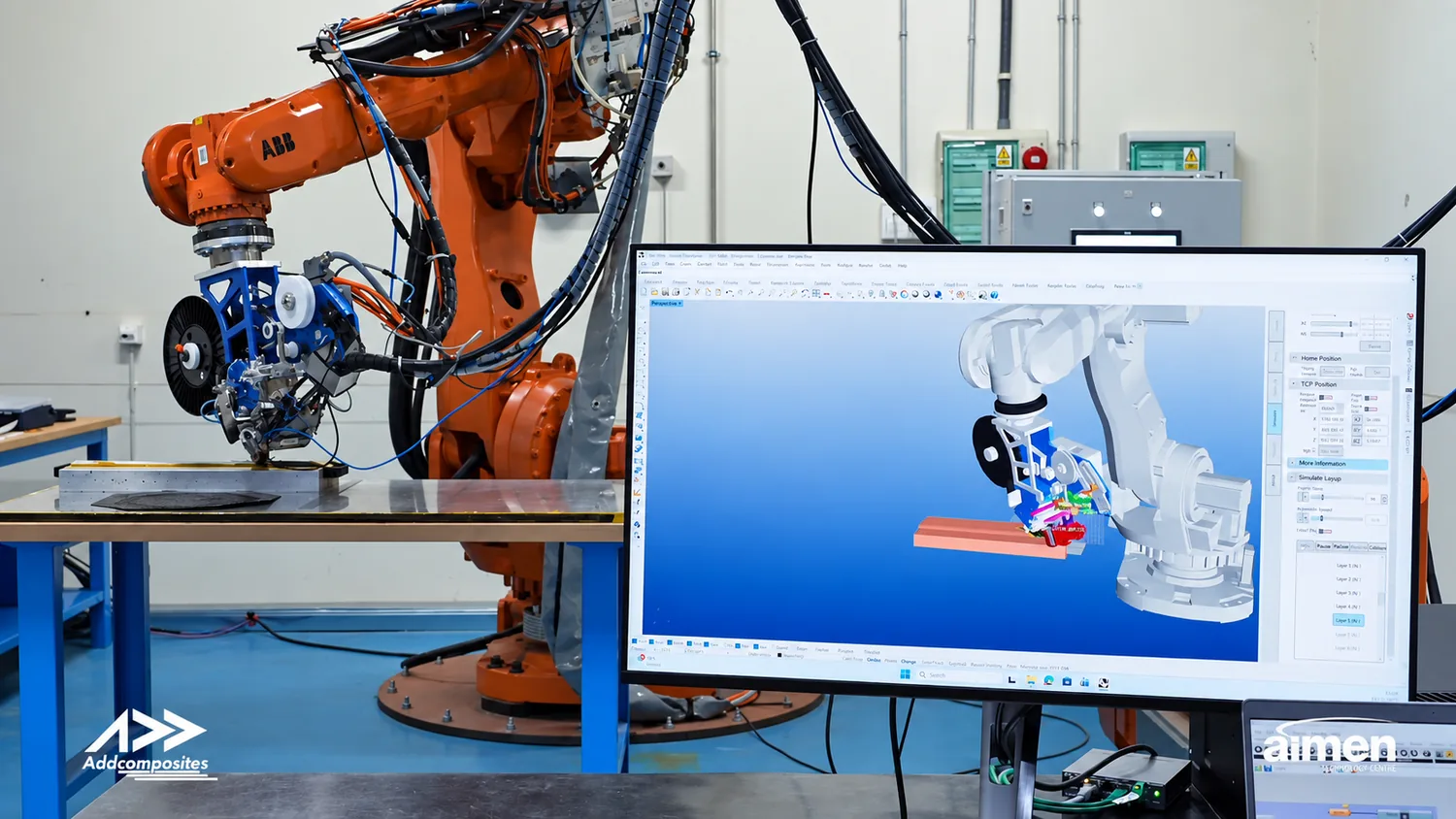
This is the thread that ties the whole review together, and it is the one that maps most closely onto where the wider market is moving. The authors argue that pairing aerospace-grade feedstock with conventional ATL and AFP equipment leaves the process too costly per part, and too slow, for the economics most other sectors work under. That mismatch, they say, is what has pushed the field toward new head designs, robotization, and cheaper machine setups.
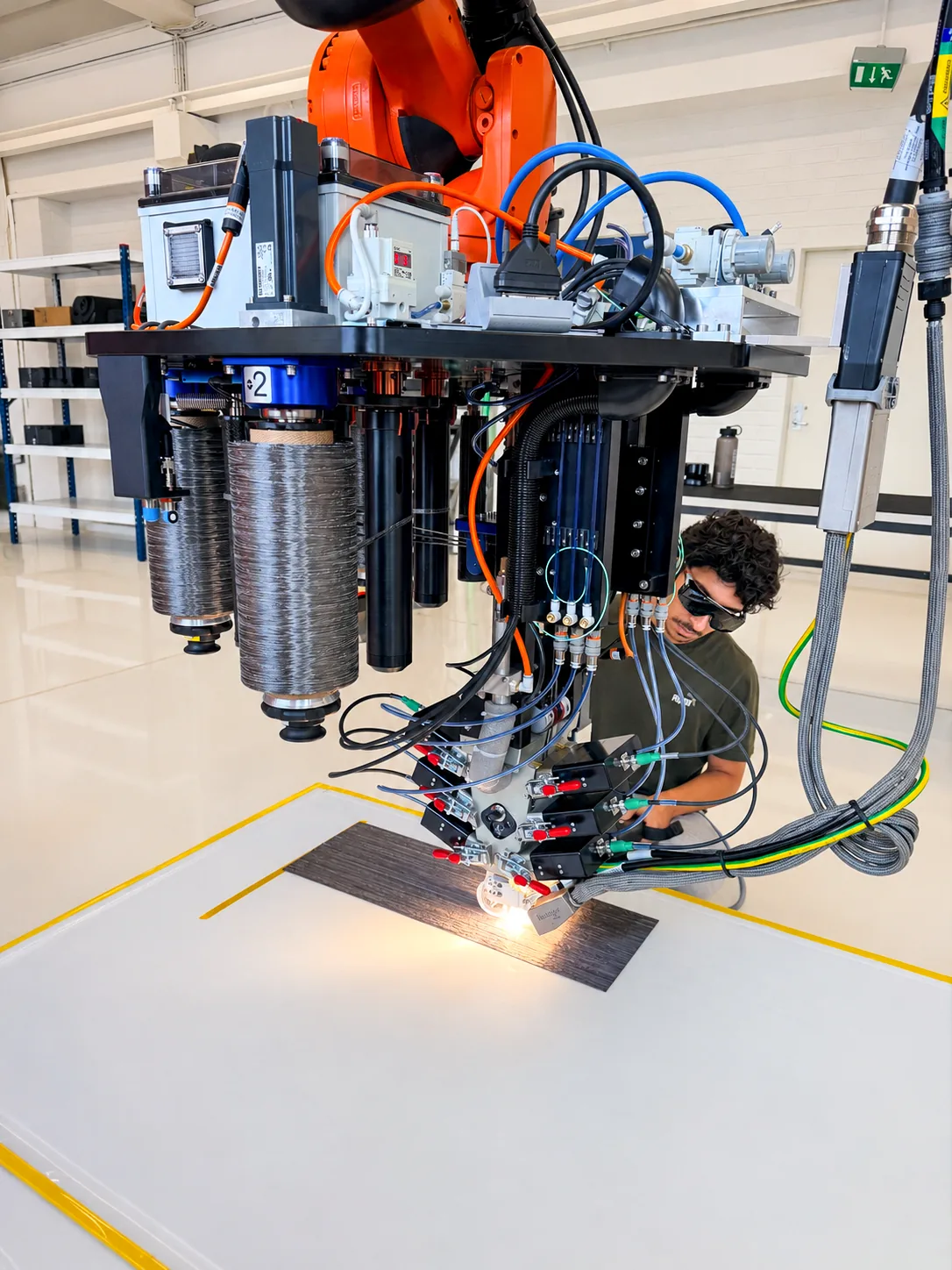
The paper points to suppliers deliberately building pared-back heads with fewer onboard sensors and inspection units, chiefly to cut investment cost so that small and medium-sized firms and research groups can take the technology up. The review itself phrases the reliability effect as reducing "the mean time between failures"; read literally that would mean failures come more often, which looks like a slip, since the evident intent is simpler, cheaper, more reliable heads. It cites the CROSSLAYER technology as one example, and reports (crediting Grisin et al.) that such simplified approaches can still balance process reliability, low material waste, and good preform quality.
Tailored Fiber Placement: reinforcement exactly where the load is
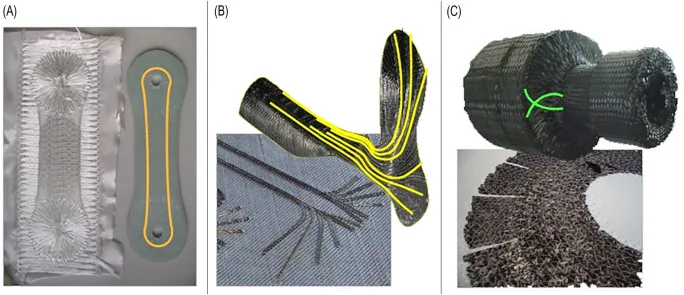
In the review's account, TFP is a textile-driven branch of the AFP family whose roots reach back to the late 1980s. Rather than a placement head, an embroidery-style machine with several heads lays the dry tow down over the routes the design calls for, tacking it to a backing fabric with a zig-zag of thin thread. Because the fibers run exactly along the load, the authors note, their directional strength does the most work it can, and thickness can be added in a given spot just by stacking more tows there.
The paper adds several concrete process details worth keeping. An overhead feeder can now handle threads as heavy as 3500 tex directly; that caps how far the fiber can twist, at roughly 720°, but it also lifts fiber quality and saves the time rewinding would cost. The thread doing the tacking is normally a thermoplastic — polyester multifilament is common — and it is chosen to be compatible with whatever resin the finished part will use. Stitch density can also be dialed up or down in specific areas to control how a flat preform drapes into a three-dimensional shape. That 2D-to-3D forming is, in the authors' account, a defining strength, and the technology already shows up in real parts: reinforced window frames on the A350, brake levers for bicycles, and heavily loaded rotor blades. The authors also flag an open question: in-line defect monitoring for TFP has not been reported yet, and it is not settled whether it would help or simply add cost and complexity, since the moving fiber guide and the machine's bar leave little room for inline sensors, while offline measurement can read only the top layer.
Robotic and coreless filament winding: composites move into architecture
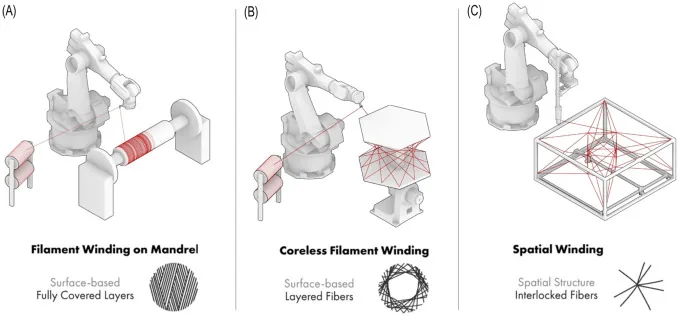
The final technology family the review covers is where it ventures furthest from traditional aerospace. The authors describe how filament winding, historically limited to rotationally symmetric parts on one or two axes, gained degrees of freedom when the deposition head was mounted on an industrial robot, allowing more complex, non-symmetric geometries.
The paper reports that CFW is being explored for architecturally striking large shell structures, often a glass-fiber shell stiffened with carbon where the loads run, and in a few projects flax. Because no standard code exists to certify these structures against, each one generally has to be signed off on its own. Even so, since CFW is already in use past the prototype stage, the authors place its technology readiness in the upper third of the scale.
A recurring engineering theme in this section is fiber tension and form-finding. According to the authors, with no convex mandrel doing the consolidating, how tightly the laminate packs comes down to several things at once: how hard the tow is pulled, how the part curves, and how many rovings ride in each bundle. Dialing in that tension packs the fibers more densely — the paper puts typical CFW fiber-volume ratios at 40 to 50% — while leaving fewer voids and lowering the chance of layers separating. And because the fibers stay limp until the resin sets, with anything wound on top pulling earlier passes out of position, the design needs a form-finding step; the review surveys several numerical relaxation and optimization methods proposed for that.
In-line inspection: the quiet enabler of the whole expansion
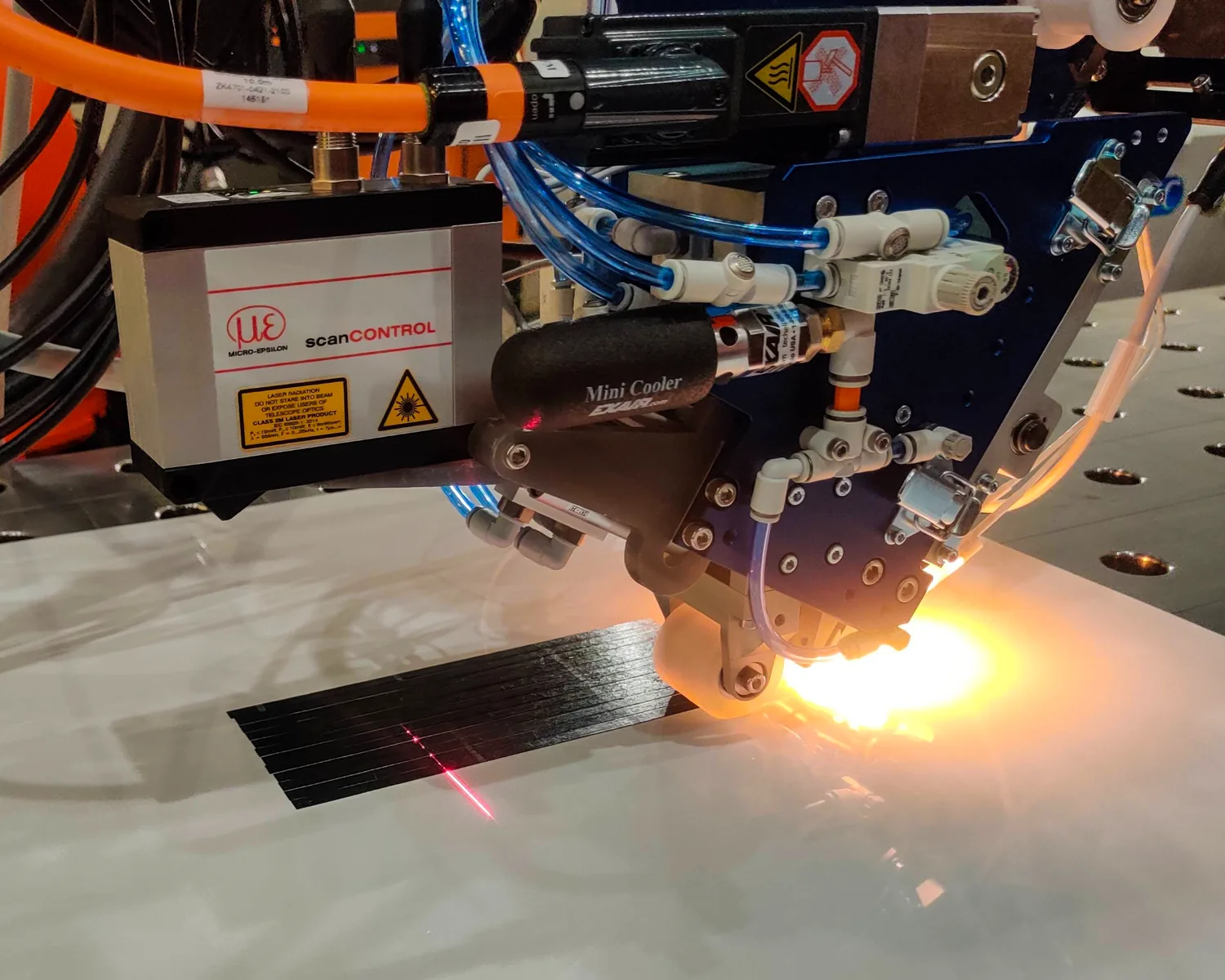
One theme cuts across every section: quality assurance. The authors emphasize that AFP is unforgiving of process error — the result hinges on getting a whole set of parameters right, from feed rate to heating to consolidation force to how fast the head moves, at every stage of a run. Building in sensors and live monitoring — the paper names heat imaging, surface profiling, and machine vision — is, they argue, what keeps quality consistent in safety-critical work.
Here the two threads meet. Our reading is that the same simplification making AFP affordable for smaller shops — leaving out onboard sensors and inline inspection to cut cost and downtime — also removes the monitoring that underwrote part quality in aerospace. That is our synthesis, not a trade-off the paper states in those terms; what the paper does say is that developing in-line quality inspection for these leaner systems will be pivotal to carrying composites further beyond aerospace.
Where this leaves the field
The authors close on a word they clearly favor: diversification. Their wrap-up is that after years of the processes and the materials advancing side by side, ATL and AFP have moved from a specialized aerospace tool to something used across industry — and that the next gains will come from dry-fiber and thermoplastic deposition, tow steering for variable-stiffness panels, robotic coreless and spatial winding for large-scale architecture, and better material modeling, including fiber-path definition that respects a machine's real limits.
Read the Research
Stefan Carosella, Sebastian Hügle, Florian Helber, Peter Middendorf. "A short review on recent advances in automated fiber placement and filament winding technologies." Composites Part B: Engineering 2024, 287, 111843. https://doi.org/10.1016/j.compositesb.2024.111843
Published open access under the CC BY 4.0 license (https://creativecommons.org/licenses/by/4.0/). All figures referenced above are the authors' own and are reproduced under that license with attribution.