ADDCOMPOSITES BLOG
The Monolithic Manufacturing Revolution: Why We're Printing Entire Structures Instead of Assembling Thousands of Parts
How Large Format Additive Manufacturing with Continuous Fiber is Eliminating the Assembly Line
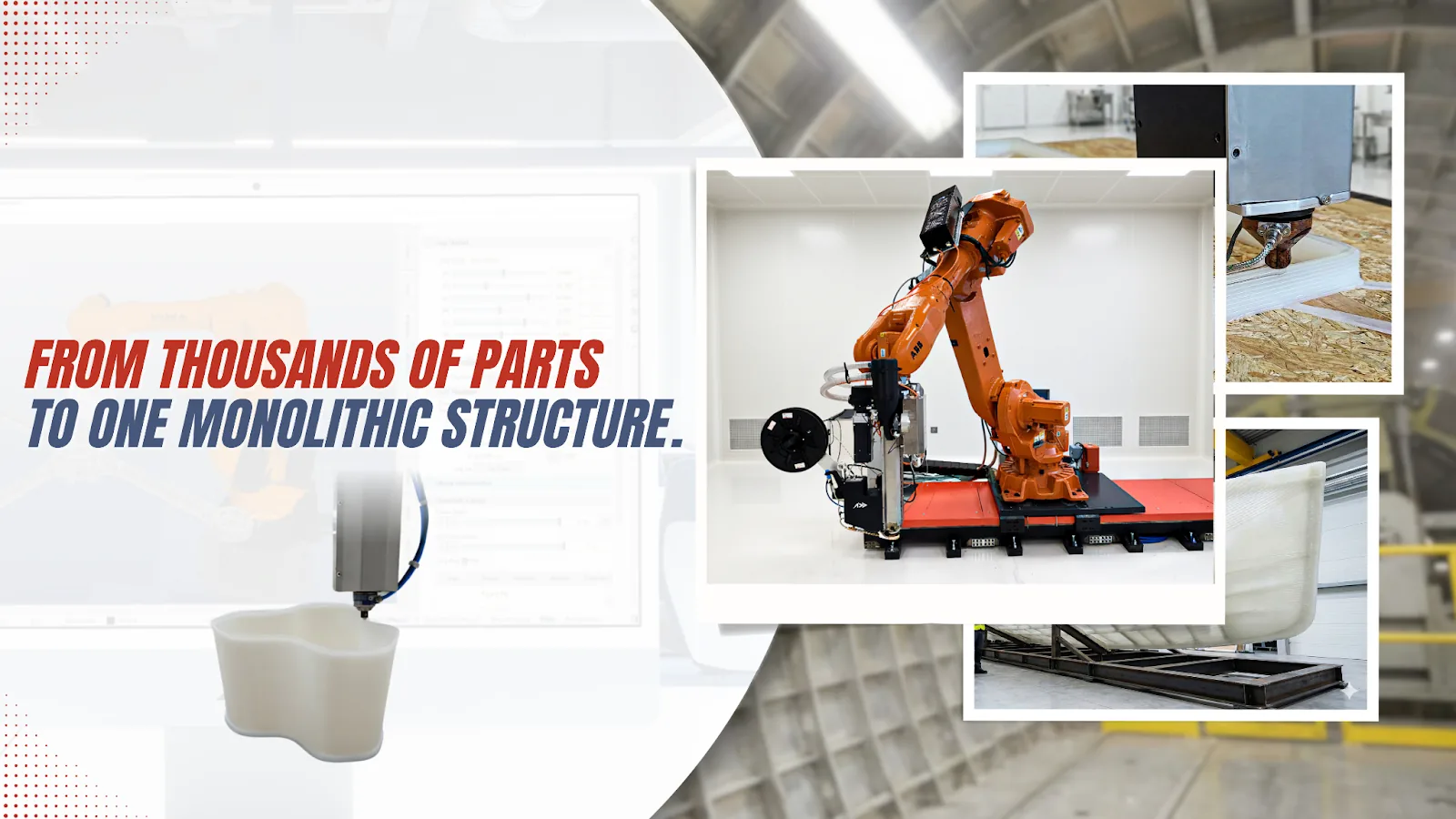
For over a century, we've been building complex structures the same way: break them into thousands of pieces, manufacture each one separately, then spend weeks or months bolting, riveting, and welding them back together. A modern aircraft fuselage? That's 2.3 million fasteners. A bus chassis? Hundreds of welded joints and bolted connections. Each joint is a potential failure point, a stress concentration, and a source of accumulated dimensional errors.
But here's the thing – we only did it this way because we had no other choice. Our manufacturing processes couldn't handle the complexity of making an entire structure in one shot.
That constraint just disappeared.
The Core Premise: One Continuous Structure vs. Thousands of Parts
The fundamental shift we're seeing is this: what if you could print a 12-meter bus chassis as a single, continuous structure instead of welding together 50+ components?
It sounds ambitious, but the technology is here, and the benefits are massive:
The Traditional Way vs. The Monolithic Way
Traditional Assembly
- 50+ Components
- 300+ Fasteners
- 8-16 Weeks Assembly
- Tolerance: ±10-15mm
Monolithic LFAM
- 1-3 Continuous Sections
- 0-10 Joining Points
- 5-10 Days Fabrication
- Tolerance: ±2-5mm
Efficiency Comparison
The Three Breakthroughs Making This Possible
1. Load-Optimized Fiber Placement
Traditional 3D printing creates parts layer by layer, with fibers running in predictable, geometric patterns. This is like building a bridge with steel beams pointing in random directions – structurally inefficient.
Modern continuous fiber LFAM does something fundamentally different: it places fibers exactly where stress wants to flow.
Load-Optimized Fiber Placement
Continuous fibers follow load paths, increasing stiffness by up to 240% compared to standard patterns.
The Results:
- +40-240% stiffness compared to standard 3D printing
- +264% peak load capacity in optimized structures
- -40% material usage by placing fiber only where needed
How We Do It at Addcomposites:

Our AddPath software integrates directly with FEA tools to generate fiber paths that follow your load cases, not arbitrary geometric patterns. Combined with our AFP-X and AFP-XS systems, you can place continuous fiber tape with unprecedented precision – whether you're reinforcing an ADDX-printed structure or creating fully optimized AFP laminates.
2. Breaking the Planar Layer Barrier
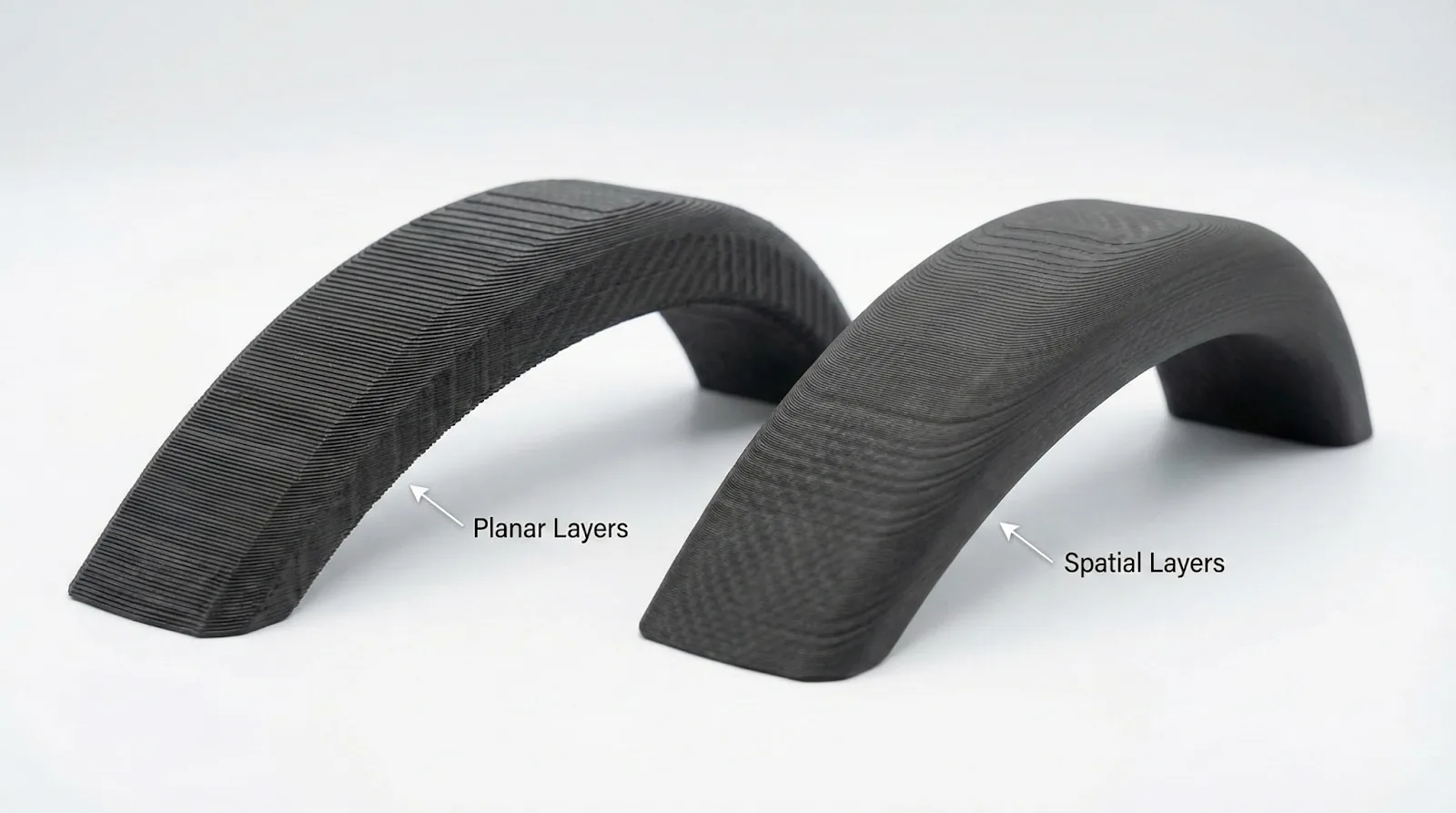
Here's a dirty secret about traditional 3D printing: it's not really 3D. It's 2.5D – stacking flat pancakes on top of each other. Every layer creates a weak interface that can delaminate under load.
Spatial printing changes this entirely. Using 6-7 axis robotic systems, we can deposit material along curved layers that follow the part's actual geometry.
Breaking the Planar Layer Barrier
6-axis spatial printing deposits material on curved layers, eliminating the "weak z-direction" problem.
The Impact:
- 5.89x higher damage initiation load vs. traditional joints
- 1.65x stiffness improvement over bolted assemblies
- Elimination of the "weak z-direction" problem
This is precisely why our ADDX system isn't just another large format printer – it's a robotic manufacturing cell capable of true multi-axis deposition. When you need to print a 3-meter component with continuous fiber reinforcement following complex load paths, you need more than a gantry moving in X-Y-Z.
3. The Economics Finally Make Sense
For decades, additive manufacturing has been "cool" but economically questionable for anything beyond prototypes. Two things changed that:
The Economics Finally Make Sense
Direct pellet-based extrusion provides composite performance at thermoplastic economics.
Material Revolution:
- 10x cost reduction: $150/kg filament → $15/kg pellets
- For a 500kg boat hull: $75,000 → $7,500 in materials
- Same material, just skipping the filament extrusion step
Tooling Elimination:
- Traditional mold for 2m automotive tool: $50,000 + 6 weeks
- LFAM: $5,000 materials + 48 hours print time
- Break-even at 200-1,000 units depending on complexity
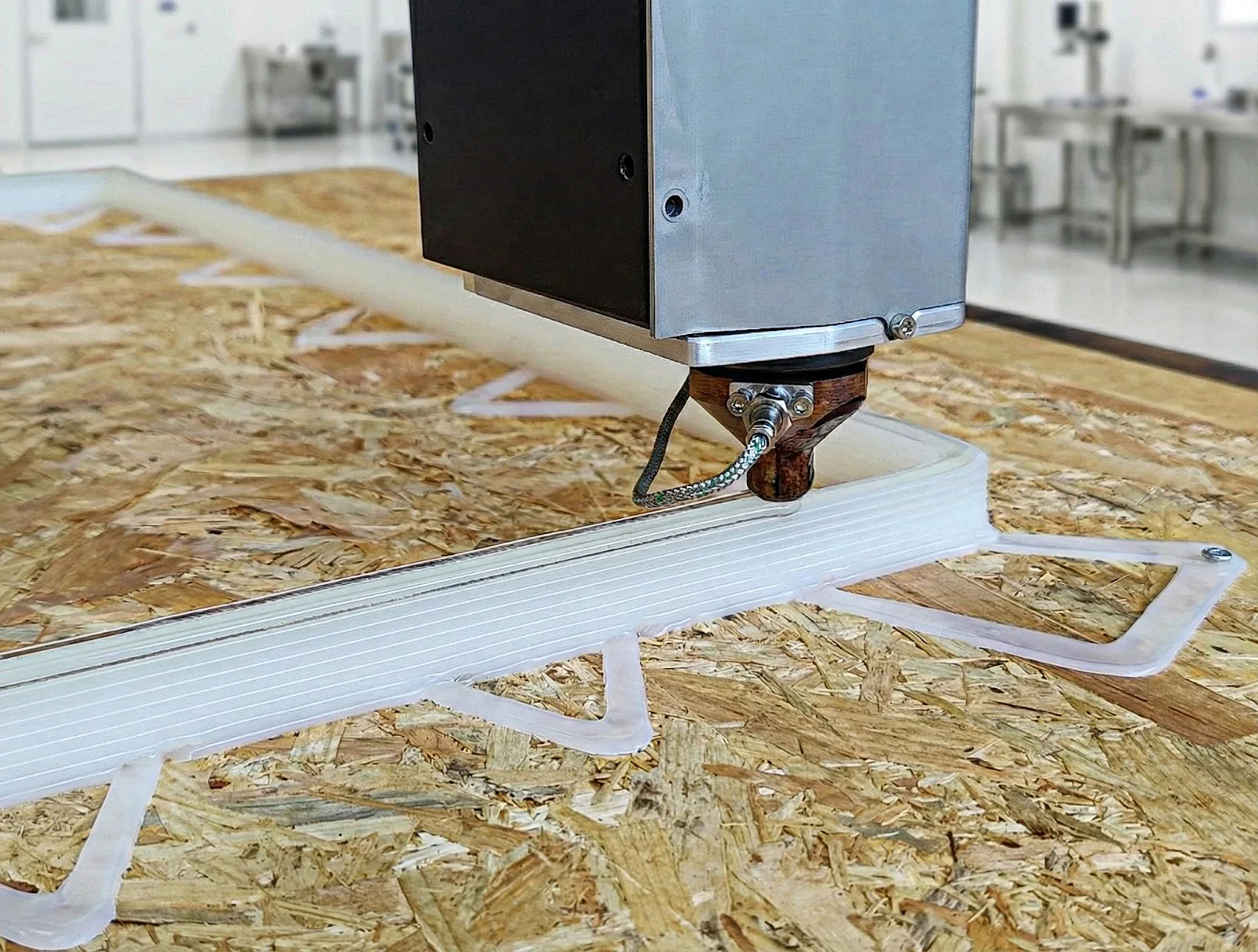
This is the core advantage of our ADDX parallel polymer-fiber extrusion system. It processes industrial pellets directly – the same materials injection molders use – while simultaneously depositing continuous fiber reinforcement. You get composite performance at thermoplastic economics.
Solving the Real Engineering Problems
Problem 1: "What About Tolerance Stack-Up?"
In a 50-component assembly, tolerances accumulate. If each part has ±0.2mm tolerance, your stack-up can reach ±1.4mm (statistical) or ±10mm (worst-case).
With monolithic manufacturing, n = 1. Stack-up = 0.
"But wait," you're thinking, "LFAM parts aren't that precise."
You're right. As-printed tolerance is ±0.5-2mm. But here's the solution: hybrid manufacturing.
The Hybrid Strategy:
- Print the structure slightly oversized (near-net shape)
- Machine critical interfaces to precision tolerances
Net result: The relative position of features is locked by the continuous structure, and absolute dimensions are controlled by CNC
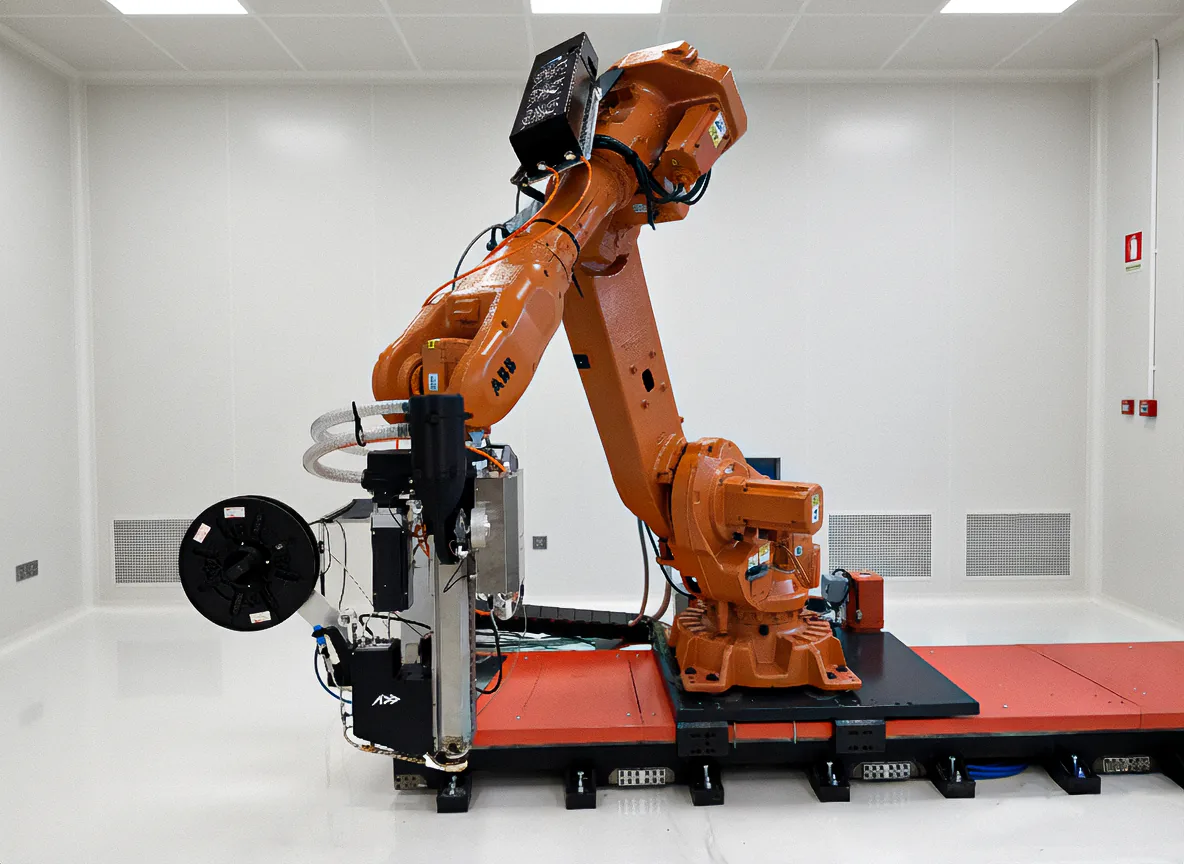
We've designed our systems (both ADDX and AFP) to integrate with standard industrial robots, making it straightforward to add a milling spindle to the same cell. Print bulk geometry, machine precision features – all in one setup.
Problem 2: "How Do You Inspect a 12-Meter Monolithic Structure?"
You can't X-ray a 12-meter part. You can't destructively test the only part you made. Traditional quality control assumes you can inspect sub-components before assembly.
The answer: continuous in-process monitoring + strategic NDT.
The Technologies:
- Infrared thermography: 94% defect detection accuracy with AI
- Laser scanning: ±0.05mm dimensional verification per layer
- Acoustic emission: Real-time crack detection during printing and service
Ultrasonic C-scan: Post-print inspection of critical areas
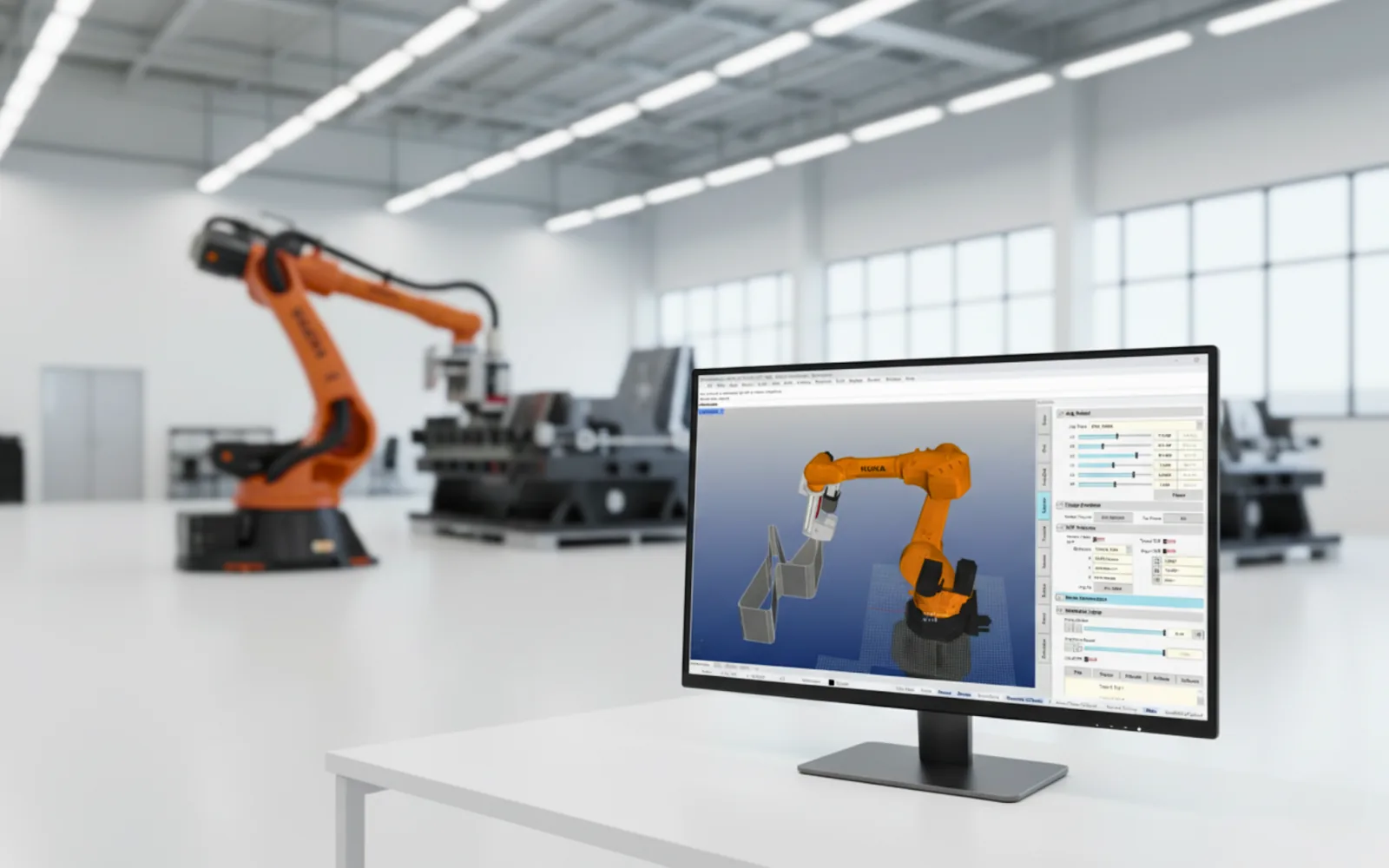
At Addcomposites, we're not just selling hardware – we're building an ecosystem. Our machines integrate with process monitoring systems, and we're actively developing AI-assisted quality control as part of our commitment to making continuous fiber manufacturing production-ready, not just prototype-capable.
Problem 3: "What If Something Breaks?"
"Great, you printed it in one piece. Now I can't replace a damaged section."
This is where thermoplastics shine. Unlike thermosets (which can't be remelted), thermoplastic composites can be welded.
Repair Technologies:
- Ultrasonic welding: 2-second cycle, 95%+ strength recovery
- Induction welding: Contactless, ideal for large seams
- Resistance welding: Proven in 50,000+ aerospace joints (Gulfstream)
This repairability is a massive advantage. You can perform field repairs on monolithic structures that would be impossible with thermoset composites. The structure remains continuous – you're not adding fasteners or adhesive bonds that create new stress concentrations.
The Industries Already Making The Shift
Marine: From Molds to Direct Printing
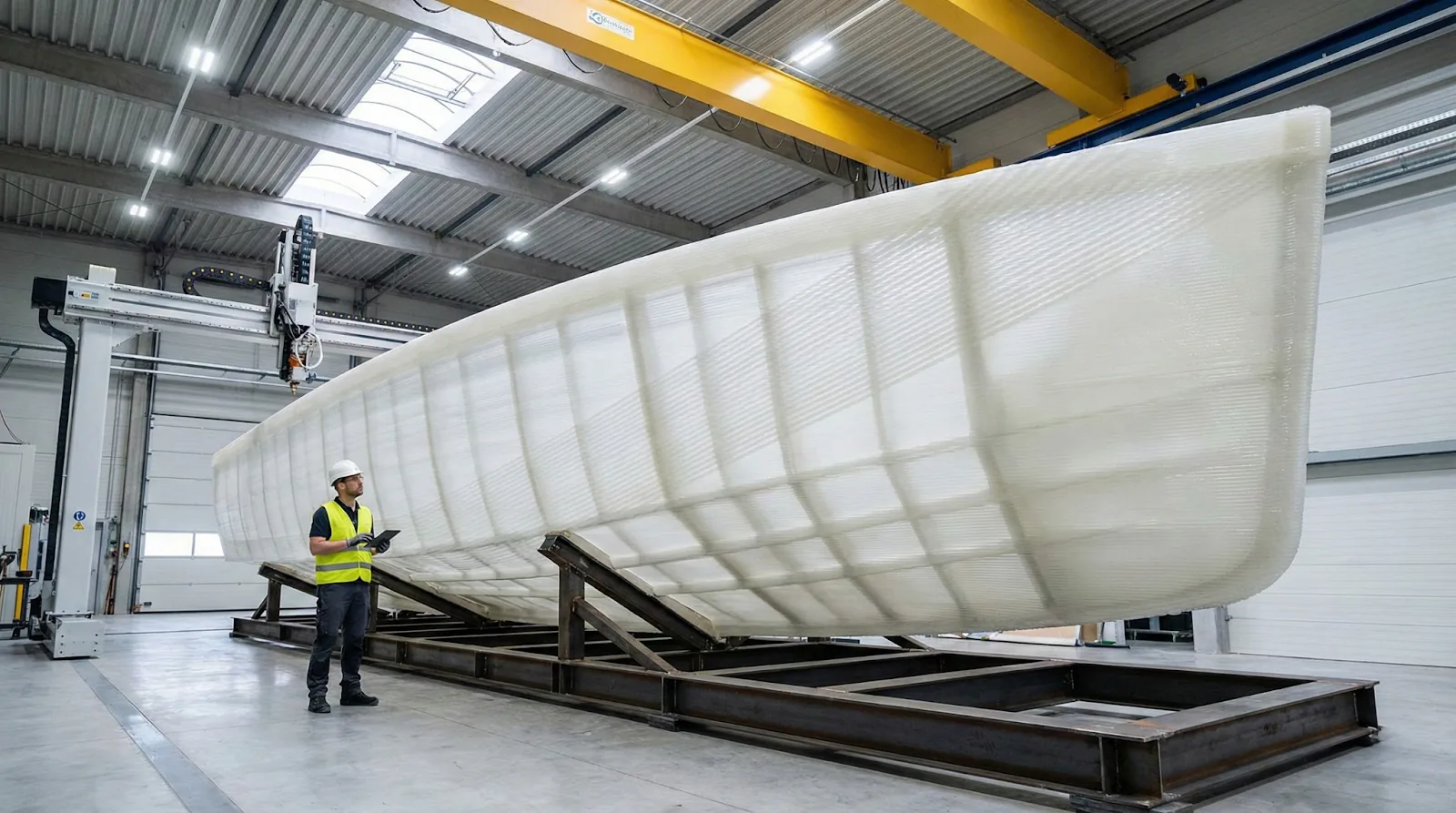
Current Reality:
- 30-foot boat hull: 6-8 weeks hand layup
- Custom mold: $50,000+, discarded after limited use
- Assembly of deck, hull, stringers: Multiple bond lines
LFAM Reality:
- Print hull directly: 5-7 days
- No mold required
- Continuous structure: hull + stringers in one operation
- Material: Recycled marine-grade pellets ($8/kg)
The marine industry is leading adoption because regulations are less stringent than aerospace, and the economic case is crystal clear. Every custom yacht is essentially a production volume of one – exactly where LFAM dominates.
Wind Energy: The 100-Meter Blade Problem
The Constraint:
- Blades >80m can't be transported by road
- Special transport >$100,000 per blade
- Road modifications, escorts, route planning
- Some wind farms are simply inaccessible
The Solution:
- Mobile LFAM units at the wind farm
- Print blade molds or structures on-site
- Economics flip at blade lengths >60m
Wind Energy: Transport Cost Curves
Marine: From Molds to Direct Printing
Printing boat hulls directly in 5-7 days, eliminating custom mold costs of $50,000+.
Aerospace: The 2.3 Million Fastener Problem
Eliminating tons of weight and stress concentrations by welding floor panels and fuselages.
For wind developers, this isn't about technology for technology's sake. It's about the only viable path to continue scaling turbine size for better energy capture.
Aerospace: The 2.3 Million Fastener Problem
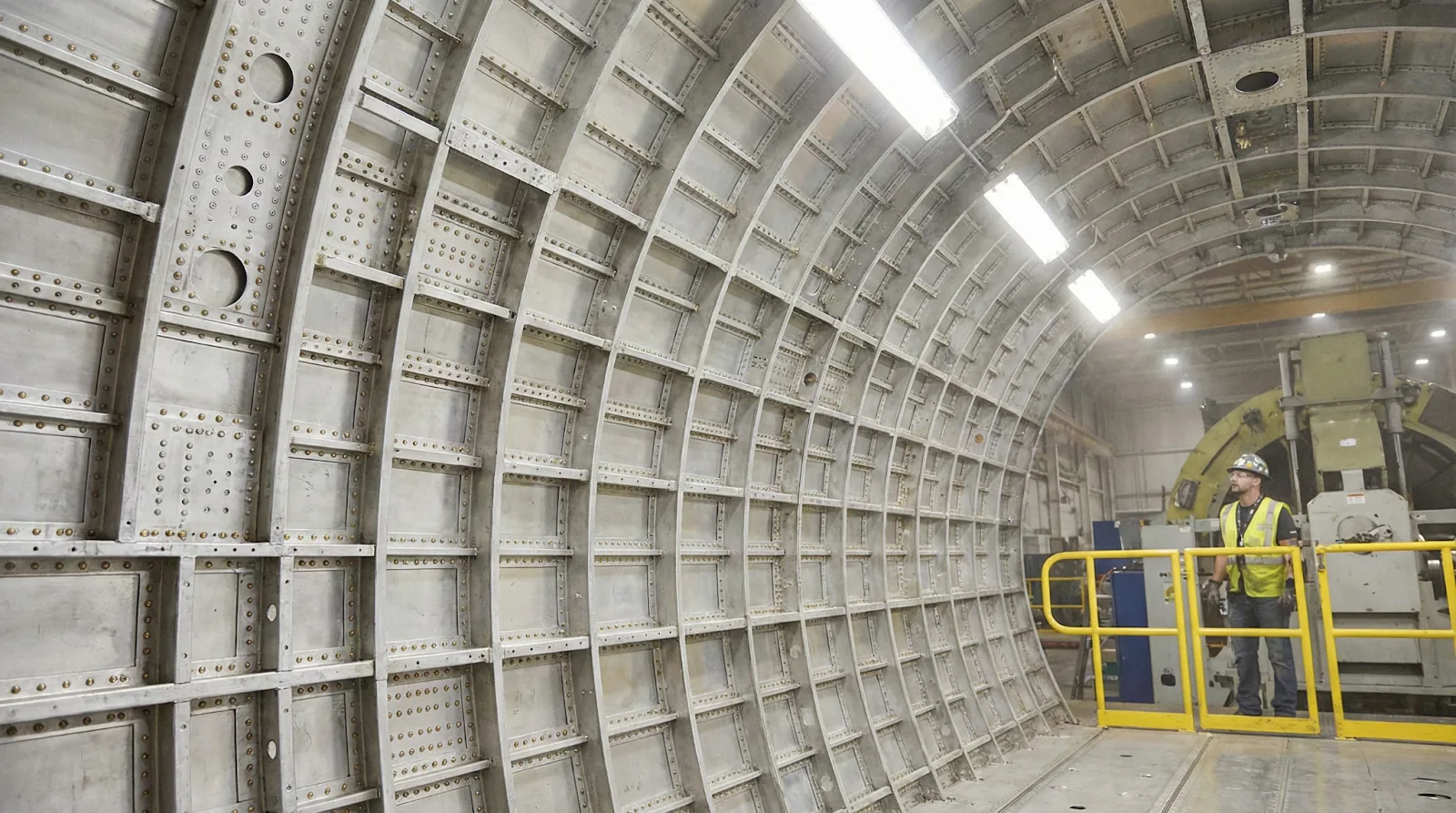
The Boeing 787 fuselage has approximately 2.3 million fasteners. Each one:
- Adds weight (1-5 grams per fastener × 2.3M = tons)
- Creates stress concentration
- Requires drilling, which damages fibers
- Needs inspection and maintenance
- Takes time to install
The Thermoplastic Composite Vision:
Gulfstream has already validated this approach at the sub-assembly level:
- 50,000+ thermoplastic components welded to floor panels
- Zero fasteners in the floor grid system
- Ultrasonic welding: proven, fast, certified
The next step is obvious: print entire fuselage sections with continuous fiber, join them with thermoplastic welding, eliminate hundreds of thousands of fasteners.
Timeline Reality Check:
- Marine: Happening now (TRL 7-8)
- Wind: 2-5 years for structural components (TRL 5-7)
- Automotive: 5-8 years for production vehicles (TRL 5-6)
- Aerospace primary structure: 8-15 years (TRL 4-5)
The technology is ready. The engineering is proven. What's left is certification, process qualification, and scaling.
Making It Real: The Addcomposites Approach
We didn't build ADDX, AFP-X, and AFP-XS to be research tools. We built them to be production systems that bridge the gap between composite manufacturing as it is today and the monolithic future we're discussing.
The Technology Stack:
ADDX (Parallel Polymer-Fiber Extrusion)
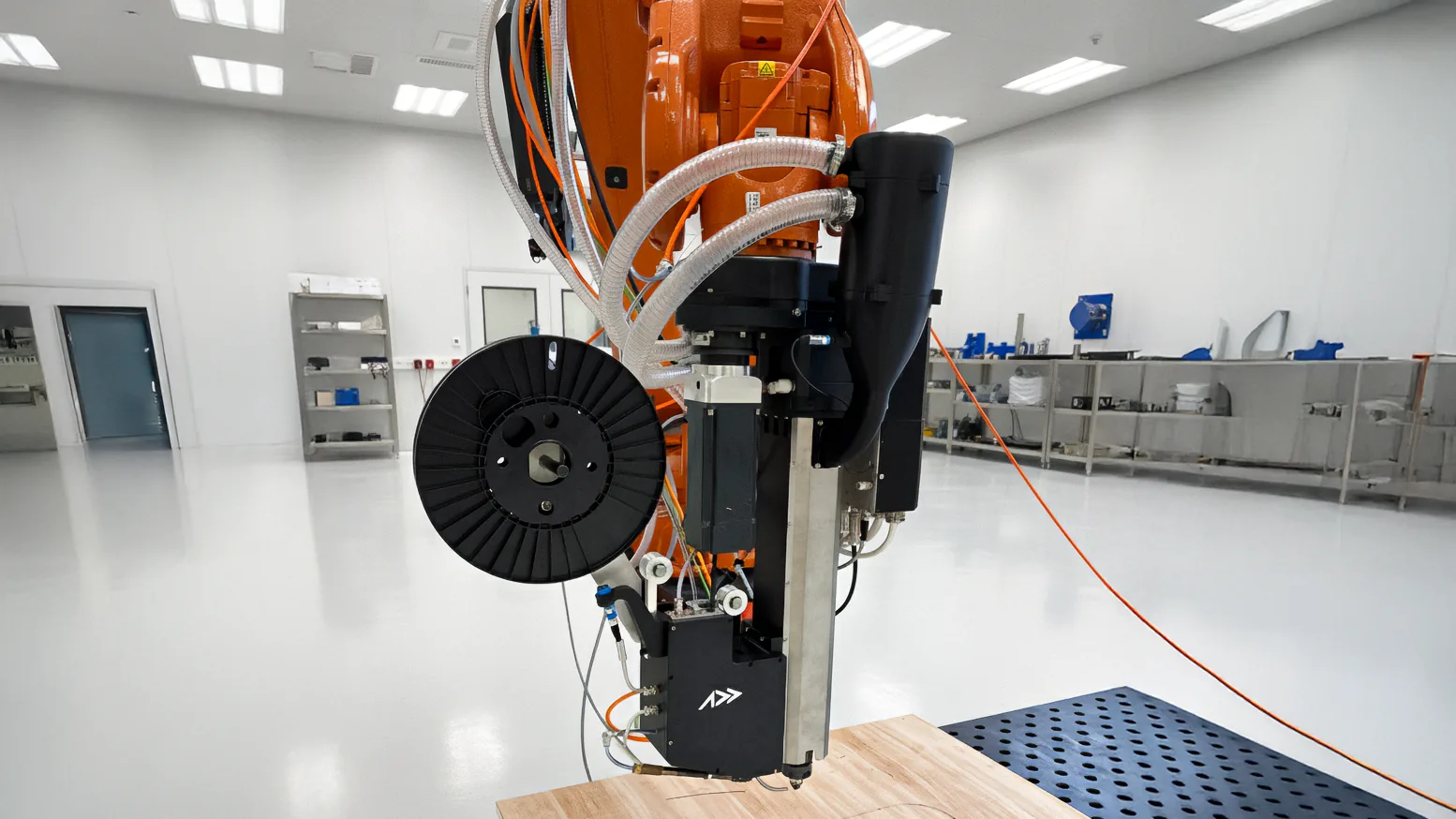
- Large format printing (up to 6+ meters)
- Industrial pellet processing ($5-20/kg economics)
- Simultaneous continuous fiber deposition
- Robotic integration for multi-axis capability
- Purpose: Bulk structural manufacturing, monolithic components
AFP-X (High-Performance Automated Fiber Placement)
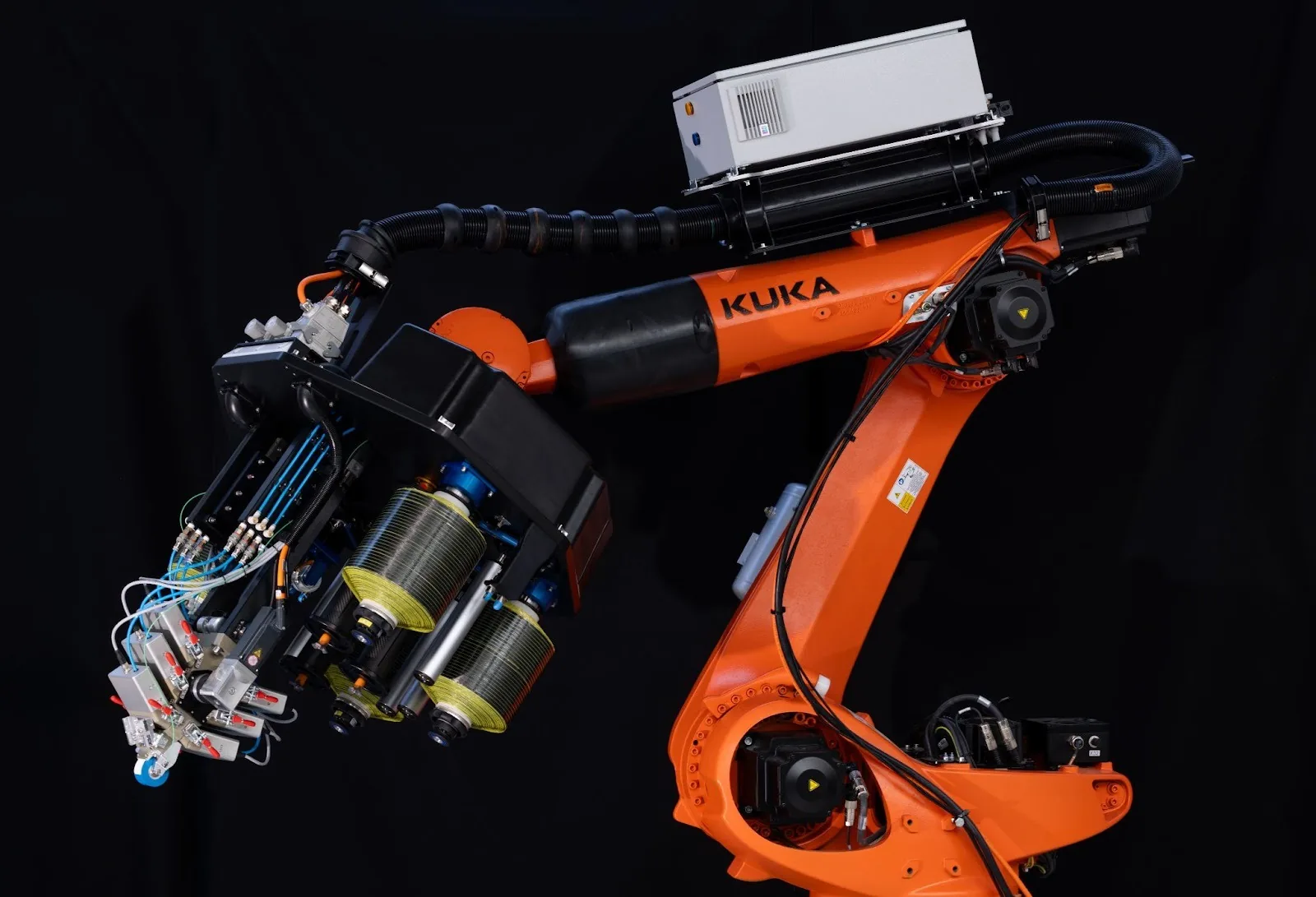
- Multi-width tape capability (1/4", 1/2", 1", 2")
- Heating systems for thermoplastic and thermoset
- Laser AFP integration ready
- Purpose: Precision reinforcement, aerospace-grade layup
AFP-XS (Compact Automated Fiber Placement)
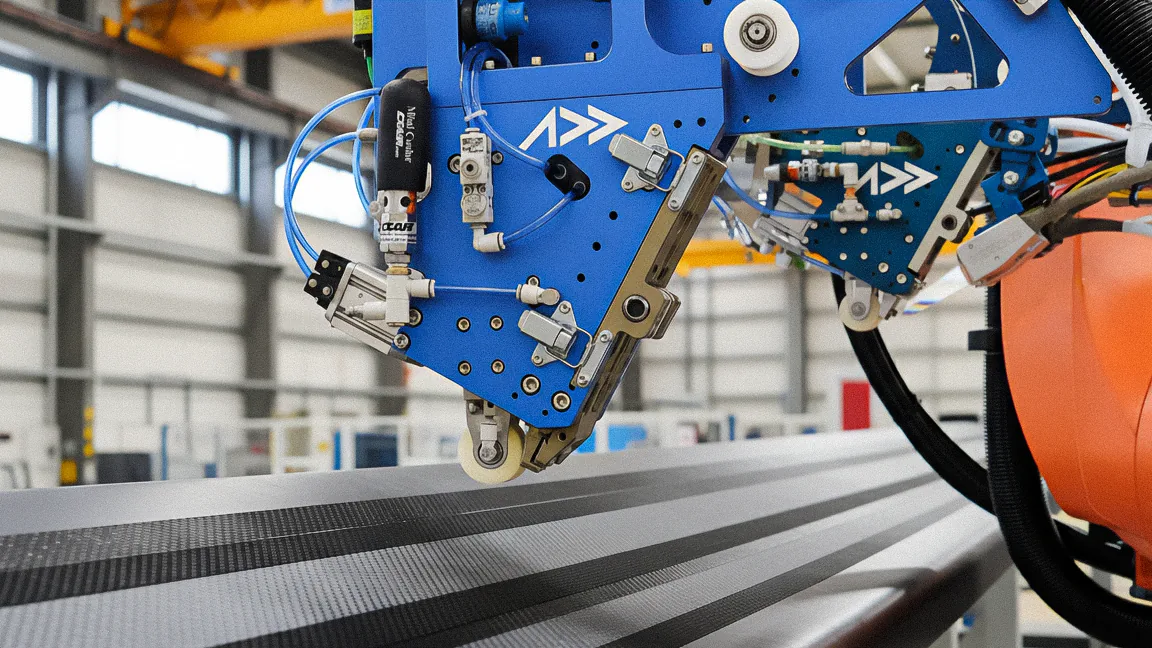
- Portable, robot-agnostic system
- Perfect for research, small series, and hybrid workflows
- Purpose: Accessibility, flexibility, R&D to production bridge
AddPath (Software Ecosystem)
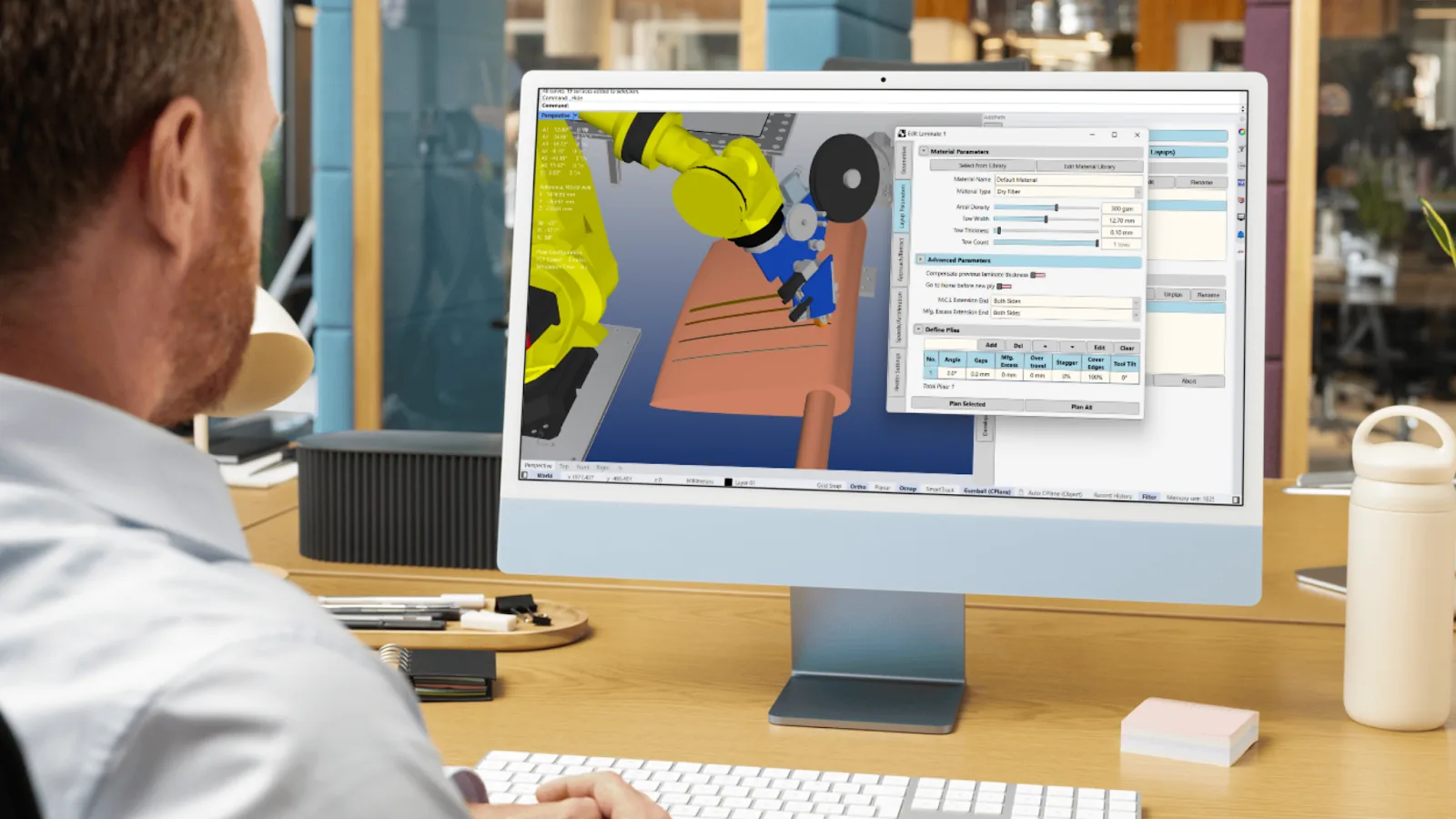
- Load-path optimization from FEA
- Multi-process toolpath generation
- Supports both AFP and LFAM workflows
- Purpose: Turning engineering intent into manufacturable reality
The Hybrid Workflow Vision:
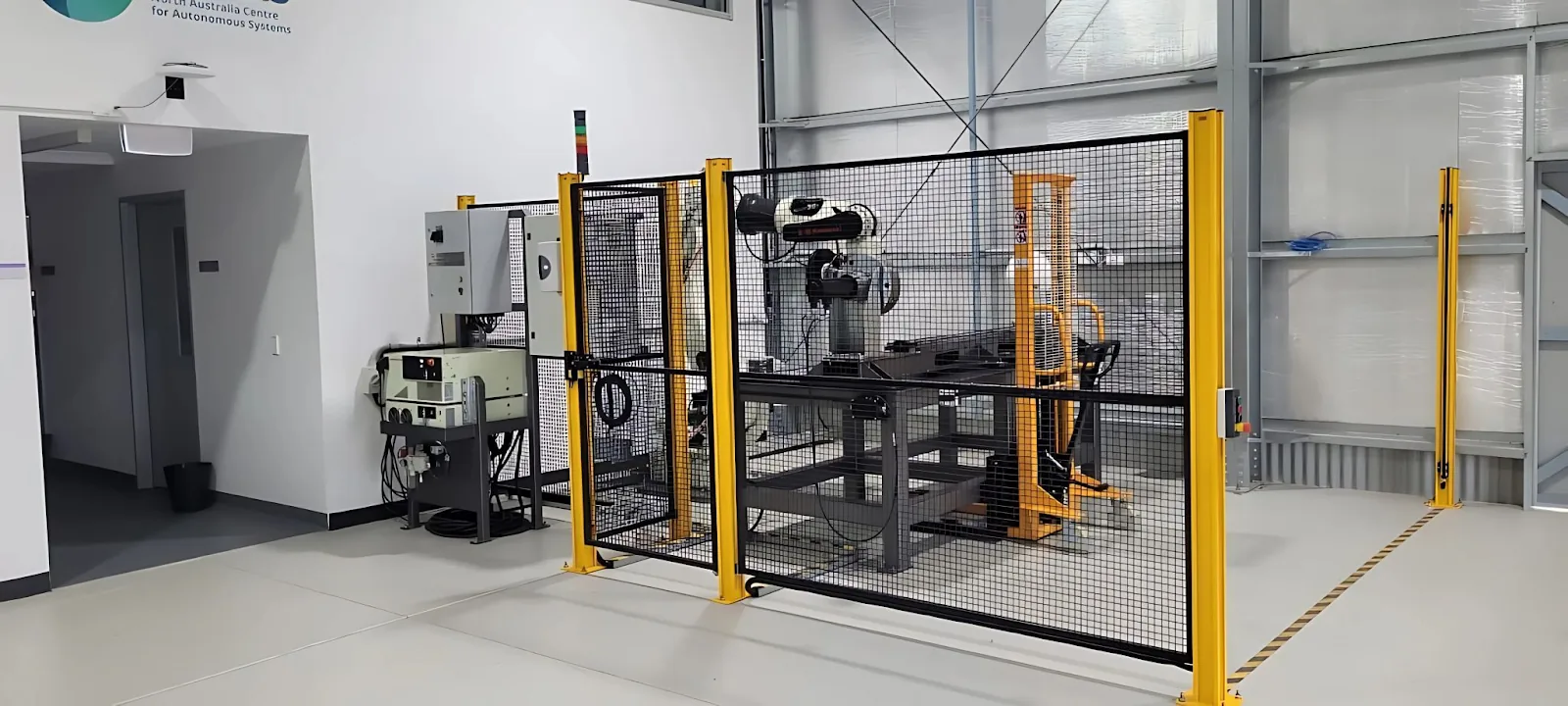
Why This Matters:
Real production parts aren't monolithic-or-nothing. They're optimized:
- ADDX prints the bulk structure (ribs, skins, core)
- AFP-X adds precision reinforcement in critical load paths
- Integrated machining achieves final tolerances
- In-situ monitoring ensures quality throughout
This is true hybrid manufacturing – using the right process for each feature of the part.
The Economic Equation
Let's get concrete. Here's the cost breakdown for a real example:
Example: 3-Meter Automotive Subframe
| Cost Element | Traditional (Stamped Steel + Welding) | LFAM + Continuous Fiber |
|---|---|---|
| Tooling | $250,000 (stamping dies) | $0 |
| Material | $120/part (steel) | $180/part (CF-reinforced pellets) |
| Labor | $80/part (welding, assembly) | $40/part (post-processing) |
| Transport | $25/part | $25/part |
| Total @ 100 units | $2,770/part | $245/part |
| Total @ 1,000 units | $475/part | $245/part |
| Total @ 10,000 units | $250/part | $245/part |
Break-even: ~9,500 units
For low-volume vehicles (EVs, specialty trucks, motorsports), the LFAM route is dramatically cheaper. For high-volume (mainstream automotive), traditional methods still win on unit cost, but LFAM offers:
- Design flexibility (no tooling lock-in)
- Rapid iteration (design changes in hours, not months)
- Lightweighting (30-40% weight reduction vs steel)
Consolidation (5-10 parts → 1 part)
The 2-7 Year Transformation
We're not talking about the distant future. The technologies are mature enough for production today:
Ready Now (TRL 7-8):
- Large format thermoplastic extrusion
- Continuous fiber placement
- Multi-axis robotic deposition
- Thermoplastic welding for assembly
- NDT methods for large composites
Maturing Fast (TRL 5-7):
- Load-path optimization (commercial software emerging)
- AI-driven quality control (94% accuracy demonstrated)
- Process simulation and digital twin
- Certification frameworks (active regulatory engagement)
Industry Adoption Timeline
The marine industry is already printing boat hulls. Wind developers are already printing blade molds. Automotive manufacturers are already testing chassis components. Aerospace companies are already welding 50,000 thermoplastic parts.
The revolution isn't coming. It's here.
What This Means For Manufacturers
If you're making large composite structures today, you have a decision to make:
Option 1: Continue with Assembly-Based Manufacturing
- Safe, proven, understood
- Increasingly expensive as labor costs rise
- Limited design flexibility (tooling lock-in)
- Slow response to design changes
- Growing transportation challenges for large parts
Option 2: Start The Transition To Monolithic Manufacturing
- Steep learning curve, but first-mover advantage
- Dramatically lower tooling costs
- Design freedom (iterate without retooling)
- Faster production for low-volume applications
- Future-proof as the industry shifts
Our Recommendation:
Start with hybrid applications:
- Tooling first: Print molds for your traditional processes (immediate ROI)
- Non-critical structures: Jigs, fixtures, test articles (build process knowledge)
- Low-volume components: Custom parts, spare parts, special editions (prove economics)
- Critical structures: Once you have process control, scale up to primary structures
You don't have to bet the company on a single technology shift. Build capability incrementally.
Getting Started: The Practical Path Forward
Phase 1: Education & Assessment (Months 1-3)
- Identify candidate parts (large, low-volume, assembly-intensive)
- Evaluate material requirements (thermoplastic compatibility?)
- Calculate economic break-even for your specific case
- Understand regulatory requirements for your industry
Phase 2: Capability Building (Months 3-12)
- Acquire equipment (LFAM system, AFP system, or both)
- Train operators and engineers
- Develop first tooling or non-critical parts
- Build material database and process parameters
Phase 3: Production Qualification (Months 12-24)
- Produce first structural components
- Validate with NDT and mechanical testing
- Establish quality systems and procedures
- Engage with certification bodies (if aerospace/automotive)
Phase 4: Scale-Up (Months 24+)
- Move from demonstration to production
- Optimize processes for cycle time and cost
- Expand to more complex geometries
- Consider mobile/distributed manufacturing for logistics
The Addcomposites Advantage

We've been laser-focused on making advanced composites accessible and practical since day one. Our systems are designed for real production environments, not just research labs.
Why Work With Us:
✓ Integrated Systems: ADDX, AFP-X, AFP-XS designed to work together✓ Accessible Pricing: €3,500/month rental option (vs $2-10M traditional AFP)✓ Global Support: Distributors in Canada, China, Japan, Korea, Saudi Arabia, UK✓ Application Support: We help you qualify materials and processes
✓ Open Architecture: Works with standard industrial robots (KUKA, ABB, Fanuc)
✓ Software Included: AddPath for process planning and optimization
We're not selling machines. We're selling capability – the ability to make things that weren't economically or technically feasible before.
Join the Revolution
The companies that will dominate the next decade of manufacturing aren't the ones with the most expensive tooling. They're the ones that can:
- Design freely without tooling constraints
- Iterate rapidly in response to market needs
- Manufacture locally to eliminate logistics bottlenecks
- Optimize structurally with continuous fiber and load-path planning
- Scale flexibly from one to one thousand units
This is the monolithic manufacturing revolution, and it's happening now.
Want to Learn More?
See the technology in action:
- Download technical documentation on ADDX and AFP systems
- Speak with our applications team about your specific requirements
Upcoming Events:
- Formnext 2025 (November 18-21, Frankfurt) - ADDX launch and live demonstrations
- JEC World 2026 (March, Paris) - Continuous fiber innovations showcase
Contact: 📧 info@addcomposites.com
🌐 www.addcomposites.com
📍 Espoo, Finland | Global Distribution Network
Addcomposites is democratizing advanced composite manufacturing through accessible, production-ready AFP and LFAM systems. From €3,500/month rental options to complete turnkey cells, we're making aerospace-grade technology available to manufacturers of all sizes.
The future is monolithic. The future is continuous fiber. The future is accessible.
Ready to eliminate assembly and embrace monolithic manufacturing?
References:
- Spatial printing research: University of Manchester & TU Delft (240% stiffness improvement)
- Load-dependent path planning: Published peer-reviewed research (40% strength improvement)
- Ultrasonic welding: Gulfstream Aerospace (50,000+ certified joints)
- Economic analysis: Multiple industry studies (break-even at 200-1,000 units)
- Adoption timeline: Industry consortia roadmaps (2-7 year horizon for production adoption)
- AI quality control: Published research (94% defect detection accuracy)
All technical claims verified through peer-reviewed research and industry demonstrations. Full technical report available upon request.